Queen of Falls

QueenFallsAnnie Taylor was the first person to go over Niagara Falls in a barrel, the first to survive, the first woman for over 95 years, and the only woman to do it alone. This is her story – the story of a woman over 60 years of age who did an amazing thing.

Chris Van Allsburg, Houghton Mifflin, ©2010, 978-0547-31581-2

Start in the Middle of the Action

This book is a brilliant example of starting a story in the middle of the action, then going back to fill in the backstory, and bringing your reader back up to the beginning point of the story.

In this book, a crowd has gathered to watch a barrel go over the falls but why is the barrel so important? The book then flashes back to Annie Taylor’s life, leads her up to the falls, and then follows on with the rest of the story. After analyzing how the “start in the middle of the action” strategy works, have students re-write a story they have written by starting at the action point and flashing back to the beginning.

Science Egg Drop Project

Annie Taylor knows, “You can put an egg inside a can and let it drop to the floor. The can may not be damaged, but it’s a different story for the egg.” This is a classic science project. How do you protect an egg from breaking in a 20 foot drop? One of the neatest demonstrations is The Science Egg Drop Project by Bradley who demonstrates 5l contraptions he built to protect an egg in a 19 foot drop. This can also make a good science challenge for your students.

For 9 writing ideas, click Queen of the Falls to download.

The Very Smart Pea and the Princess To Be

princessandpeaThe pea under the mattress writes a memoir of his attempt to help the prince find a “real princess.” Eventually the gardener’s girl who raised the pea lies on the twenty mattresses and he whispers, “You are very uncomfortable,” in her ear all night. She repeats this to the queen in the morning and marries the prince. The pea lives on in the royal museum.

Mini Grey, Alfred A. Knopf ©2003 ISBN 0-375-82626-2 (trade) and 0-375-92626-7 (library)

Fairy Tale Recipe Book

The pea is brought to the palace for a special recipe of Pea and Raspberry Jelly.  Why not use this as an opportunity to create a Fairy Tale cookbook?

First collect about six recipes from different cookbooks with different formats. Make copies for each group of 4 students and ask them to identify the critical elements of a recipe. They should come up with: title, ingredients list with the measurements needed, the temperature of the oven, step by step instructions, length of cooking at what temperature, preparing the pan (grease, lined, etc.), how many it serves, and so on.

Students can then brainstorm appropriate recipes for different fairy tales: Gingerbread Boy’s Gingerbread – Run Away Good, Goldilocks “Just Right” Porridge, Snow White’s Candied Applies, Cinderella’s “Fits Right” Pumpkin Pie, and so on.

You could create a class book of recipes where each page has: a picture of the cover of a sample fairy tale book, a 10 line summary of the story, and the recipe with its new Fairy Tale title. Suggestions for occasions to serve it would be great. Putting the finished bound book in the library can be great.

My Artefact

The pea becomes an “artefact” in the royal museum. The word comes from the Latin meaning “arte” (by hand) and “fact” (an object). An artefact is any human-made object which illustrates something about a culture. It is studied by archeologists and often displayed in museums. In fantasy games, an artefact is an object from a long lost culture that has magic powers. Your class constructs a “museum” of of artefacts from their year—posters of favourite songs, favourite commercials, favourite activities, school events, favourite foods, etc. Alternatively, a class museum can be constructed as each student brings an artefact that has associations for him/her and displays it with a poster explaining its “archeological meaning” from their life.

For 5 writing ideas, click Princess and the Pea to download.

The Diary of Hansel and Gretel

Diary of Hansel and GretelThe story of Hansel and Gretel as told by Gretel, in her own voice and with her point of view. A very clever pop-up story—and a potential model for student pieces.
Kees Moerbeek, ©2002, Simon and Schuster, ISBN 0-689-84602-9

Write a Point of View

Any of the fairy tales, or indeed a part of any novel, or a historic event, can be rewritten into the form of a diary of one of the characters. In this way, the character can be given his or her own peculiar qualities that can come our in the telling. In this story, Gretel is just a little acerbic. She doesn’t have much confidence, deservedly, in her brother Hansel but she loves him and saves him anyways.

Students can take a fairy tale and and rewrite it from the point of view of one of the characters. Cinderella;s story could be told from the point of view of one of the stepsisters, or one of the mice, to the fairy godmother. The fairy godmother, for example, might think that Cinderella is a little bit of a whiner—always calling for help and crying instead of helping herself.

mocknewspaper

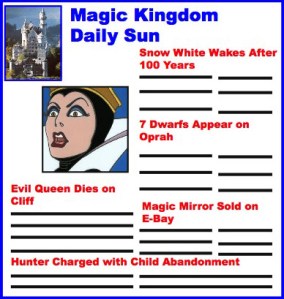
Creating a Mock Newspaper

A mock newspaper story is a great time to teach how to write a newspaper story. Elements that matter are that the paragraphs are short with only one or two sentences. The lead paragraph contains the who, what, where, when, why, and how of the story. Quotes of in the middle. It should be able to cut from the bottom to fit in the newspaper.

Working in teams of 4–5, students can choose a fairy tale then write an entire front page of newspaper stories that might emerge from the fairy tale they have chosen.

For 5 writing ideas, click Diary of Hansel and Gretel to download.