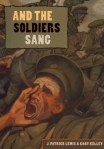
 A gorgeous moving story of the Christmas truce during World War I, when both sides left the trenches, sang carols together, exchanged gifts, shook hands, and then went back to killing each other.
J. Patrick Lewis and Gary Kelley, Creative Publications, ©2011, 978-1-56846-220-2
World War I Songs
Click here, World War One Music and Songs. for a really good site with most of the songs from WWI. Click here, for a really good film portraying the moment shown in this book when the Germans sang Stille Nacht and the war stopped. Terrific to show the students.
Other songs of World War I are sung on this website as well. This site is a great resource.
In Flanders Fields
Canadian John McRae wrote In Flanders Fields. This is a great poem to memorize because it is perhaps the most quoted poem of the war, it is Canadian, and it is a good sample to show how easy it is to memorize a poem. It’s very moving, very stirring.
Tips for Memorizing Effectively
- Consider its meaning and structure – you should see it like a movie.
- What is its shape? How many lines? How does it rhyme?
- Create physical movements – act it out.
- Memorize each part separately.
- Involve your senses – write it, shout it, cry it, laugh it,hear it.
- Practise starts AFTER you learn it. Repeat at intervals, up to 11 times.
For 8 creative writing ideas, click And the Soldiers Sang to download.
 Our illustrator is racing through the book trying to tell the story of a pie-loving king who has imprisoned his stepdaughter. He will only release her when a suitor kills the dragon. We, “the readers”, are reading too fast for the illustrator to keep up. This results in emergency art substations that detour our plot.
 Night Flight has few words. It concentrates on just 14 hours and 56 minutes of time, starting in the evening from Harbour Grace in Newfoundland on May 20th, 1932, and ending in Ireland. The author recreates the experience in vivid descriptive language of what she had to do to stay awake, storms, failure of equipment, flying through the night. The author also describes what is seen from the plane as she left, during the night, flying over tundra, approaching land in Ireland. Imagine the Irish farmer coming toward this strange vehicle that had landed in his field, and the woman waving and saying, “I’ve come from America.” Amazing.
 The author’s child learns in school that the Wright Brothers invented flight. Her Brazilian husband says, “No they didn’t. It was Alberto Santos-Dumont”.
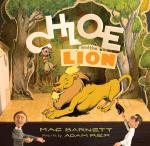 The author begins by presenting us with his character, Chloe, and asks the illustrator to menace her with a lion. The illustrator thinks it should be a dragon, which starts the quarrel. The illustrator torments the author sufficiently that the author fires him, and, in fact the lion the second illustrator creates eats him. Unfortunately, the second illustrator is really bad and finally Chloe and the author agree that they need to apologize to our first illustrator. They phone him, inside the lion’s stomach, and eventually he, the author, and Chloe become reunited.
 This is the story of Mark Twain’s life in picture book form, with accompanying anecdotes from Susy who is writing this memoir so we can meet the “real” Mark Twain. Susy, Mark Twain’s favourite daughter, did keep a memoir of observations of her dad for a short period of time, and excerpts from it are included as little fold out pages. She talks about their home, his writing process and the role her mom plays, his leisure activities, and much more.
 James advises his younger brother on the 10 things you must not do if you ride the school bus. They range from not sitting at the front, not sitting at the back, not making eye contact with the bully, to not touching the bully’s stuff, not sitting with a girl, and finally to not talking to the bus driver. During the course of the day, his brother inadvertently breaks all 10. But he discovers that things work out and makes a rule 11—you don’t have to pay attention to the rules.
 Ed Young is well known for his picture books. The House Baba Built is more in the nature of a memoir of his childhood in the house his father built in Shanghai in which the family lived during World War II. We learn about the war, school, family activities in the house, taking in refugees including a Jewish family, food shortages, being unable to fill the pool…all through his eyes as a child. You can take just a part of this book for a rich study of many different topics.
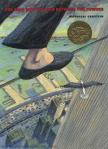 Philipe Petit was always challenged to walk the tightrope in as many difficult places as possible. As the twin towers were going up in New York in 2001 he determined that he would have to walk before it was finished and occupied. He organized friends, snuck in the ropes and rigging he would need with friends, suspended the rope and then he walked out into the wind. He walked, danced, ran, knelt, and even lay down on the rope. When arrested he was sentenced to perform for students in Central Park. The book ends poignantly with the shadows of the towers after the attack on September 11, 2001.
 Bridget’s loves to draw and is inspired by her beret. Unfortunately one day the beret blows away, and Bridget resorts to many other types of hats. None of them is inspiring. She is suffering from “painters block” until one day her friends who are opening a lemonade stand need a sign.. Bridget makes a series of signs (in the style of Whistler’s Mother, Van Gogh’s Starry Night, Andy Warhol’s Tomato Soup etc.). Her signs are viewed as an outdoor exhibit as passers by purchase lemonade at the “refreshment stand.” Of course, it ends with Bridget re-inspired to paint. This book also includes 2 pages of How to Start Your Art.
 Diana Cruchley