 Based on the original poem of the story of the fly who is flattered into stepping into the spider’s web, this picture book is beautifully illustrated in black and white. The spooky Victorian house is the perfect setting for the tale.
Mary Howitt, Simon and Schuster, ©2002, ISBN978-0-689-85289-3
A Non-Aesop Fable
This is a fable not written by Aesop. What are the characteristics of a fable that demonstrate that this is one:
- animal characters—behaving in their stereotypes
- a moral to the story
- succinct
- animals are anthropomorphized
- frequently doesn’t have a “happy ending”
The Moral of the Story
Fables always have a moral. The rhyming moral of this story is:
“And now, dear little children, who may this story read, To idle, silly, flattering words I pray you ne’er give heed; Unto an evil counselor, close heart and ear and eye, And take a lesson from this tale, of the Spider and the Fly.”
Be sure students know what that means. Do they agree that it is the moral of the story? What modern “schemer’s webs” might there be to tangle you up?
- internet fraud
- internet predator
- free “start up” drugs
For 7 creative writing ideas, click The Spider and the Fly to download.
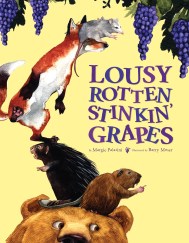 In this twist on Aesop, the fox progressively involves a series of animals in an elaborate plan to help him get the grapes. He refuses to listen to their advice, and when his plan fails, he leaves saying the grapes are probably not ripe. After he leaves, the other animals get the grapes.
 Our fox makes somewhat of a “Rube Goldberg” plan, each part of which is more elaborate than next, and requiring ever more complicated diagrams. The original model of a plan that is too elaborate is named after Rube Goldberg. The illustration is of a machine to brush your teeth. Ask students to create a “Rube Goldberg” plan to do something simple like wash a car, or sharpen a pencil.
 A wonderful retelling of the Aesop fable where the fox makes frequent attempts to get at the grapes until he finally says that they are probably sour anyway. Hence the expression “sour grapes”.
 Diana Cruchley