The Bravest Man in the World

Wallace Hartley is the man who played the violin as the Titanic sank. He was praised as the “bravest man in the world” because he was offered a space on a lifeboat, but instead stayed to calm the scared passengers by playing as the ship sank. The story is told by Jonathan Harker, a stowaway befriended by Hartley, to his grandson who doesn’t want to practice the piano.

Patricia Polacco, Simon and Schuster, ©2019, ISBN 978-1-4814-9461-8

Inquiry: Famous Disasters at Sea
It might make a good “rapid research” inquiry topic for students in pairs to find the basic when, where, why, how for the disasters. They need to also create ten interesting sentence facts about the disasters.

They could also pose questions themselves for all disasters: What are the most common causes of marine disasters? Were any changes to the “rules” of the sea made after the disaster? Why do we particularly remember these disasters? How many people died? How do we know these disasters occurred?

It helps if the students generate the questions themselves. At the end, create a chart with questions down one side and disasters across the top. With each question, have students chime in anything that found that would help to answer the question. This is genuine evidence-based research of the kind for which scholars get doctorates. Example of past famous disasters at sea are:

  • The Mary Rose, 1545
  • The Spanish Armada, 1588
  • The Vasa (Swedish), 1628
  • The Merchant Royal, 1641
  • The Scilly Naval Disaster, 1707
  • The Black Swan, 1804
  • The Tek Sing, 1822 (China)
  • The HMS Birkenhead, 1845
  • The Titanic, 1912
  • The Kiche Maru Typhoon, 1912 (Japan)
  • The Great Lakes Storm, 1913
  • The Lusitania, 1915
  • The Halifax Explosion, 1917
  • The Bismarck, 1941
  • The Wilhelm Gustloff, 1945
  • The Edmund Fitzgerald, 1975
  • The Exxon Valdez, 1994

Other Picture Books About the Titanic
There seem to be innumerable books about the Titanic written with children in mind: pop-up books, colouring books, detective books, etc.
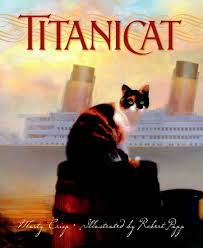
Titanicat (click for teaching ideas) is the story of a genuine survivor of Titanic who by a twist of fate did not get on the ship.

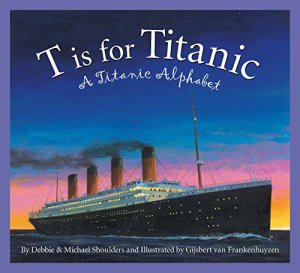
T is for Titanic is an ABC book for words from the Titanic. I have always had success with selecting a topic under study in Social Studies and having students working to create an ABC book of short paragraphs about that topic. If you have lots of time, students can work in pairs to create the book with each student doing 13 letters, but it can also be done where the class generates a list (or you do) of words that apply. Have students individually finds facts and write an interesting paragraph about the the word as applied to the topic such as the ABCs of Egypt, Haida, Japan, etc.

For more creative writing ideas, click on The Bravest Man in the World to download.

The Boy Who Grew a Forest

The story of Jadav Payeng, India, who started with a thicket of bamboo to stabilize an island that was being eroded away and over his lifetime has grown to a 1300-acre forest. It’s about the difference a single person can make.

Sophia Gholz, Sleeping Bear Press, ©2019, ISBN 978-1-5341-1024-3

Tree Proverbs
In every culture, around the world, there seem to be proverbs and sayings involving trees. Give each group four proverbs and ask them to discuss and prepare a written explanation of their meanings. Each group should have a unique set and then reports to the whole class the meaning of one of their sayings. Some examples are:

  • A little axe can cut down a big tree. (Jamaica)
  • The one who plants the tree is not the one who will enjoy its shade. (China)
  • Big trees cast more shadow than fruit. (German)
  • The taller the tree the harder the fall. (Dutch)
  • Do not cut down the tree that gives you shade. (Arab)
  • Useful trees are cut down first (Korea)
  • The best time to plant a tree was 20 years ago. The second best time is now. (Chinese)
  • The tree falls the way it leans. (Bulgaria)
  • The creation of a thousand forests is in one acre. (USA)
  • All birds flock to the fruitful tree (Senegal)

Poetry and Art
A considerable number of poems have been written in tribute to trees, or about walking through trees. Why not add poetry to your tree unit?

  1. Stopping by Woods on a Snowy Evening (Robert Frost)
  2. Trees (Joyce Kilmer)
  3. Birches (Robert Frost)
  4. The Loveliest of Trees, the Cherry Now (A.E. Housman)
  5. The Way Through the Woods (first stanza) (Rudyard Kipling)

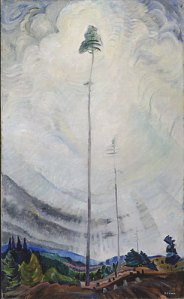
Emily Carr was one of BC’s first “environmentalists”, showing in her art both the beauty of the forest, and the destruction wrought by forestry. There is a large collection of Emily Carr at Vancouver Art Gallery. Give your students a large sheet of watercolour paper (or regular paper if watercolour is too expensive) and a limited period of time (15 minutes?) To create an “interpretation” of an Emily Carr painting. This one is usually called Lone Pine.

True and Yet Not True?
First, show the students the images in the book and ask them to talk about how old Jadav is, how much life his 40 acres can support, whether he was ever employed, and how he makes a living. Second, give the students articles about the real story that this book is based on. Get students to discuss:

  • Is it OK that the story isn’t exactly precisely true, even though he is the actual person who did create a forest on his own and has certainly dedicated his life to doing it for no money?
  • Why would the author take liberties with the story?
  • Would the story be just as interesting and just as inspiring for young people if it were “factual”? What parts make it inspiring?

For more creative writing ideas, click The Boy Who Grew a Forest to download.