
The story of Jadav Payeng, India, who started with a thicket of bamboo to stabilize an island that was being eroded away and over his lifetime has grown to a 1300-acre forest. It’s about the difference a single person can make.
Sophia Gholz, Sleeping Bear Press, ©2019, ISBN 978-1-5341-1024-3
Tree Proverbs
In every culture, around the world, there seem to be proverbs and sayings involving trees. Give each group four proverbs and ask them to discuss and prepare a written explanation of their meanings. Each group should have a unique set and then reports to the whole class the meaning of one of their sayings. Some examples are:
- A little axe can cut down a big tree. (Jamaica)
- The one who plants the tree is not the one who will enjoy its shade. (China)
- Big trees cast more shadow than fruit. (German)
- The taller the tree the harder the fall. (Dutch)
- Do not cut down the tree that gives you shade. (Arab)
- Useful trees are cut down first (Korea)
- The best time to plant a tree was 20 years ago. The second best time is now. (Chinese)
- The tree falls the way it leans. (Bulgaria)
- The creation of a thousand forests is in one acre. (USA)
- All birds flock to the fruitful tree (Senegal)
Poetry and Art
A considerable number of poems have been written in tribute to trees, or about walking through trees. Why not add poetry to your tree unit?
- Stopping by Woods on a Snowy Evening (Robert Frost)
- Trees (Joyce Kilmer)
- Birches (Robert Frost)
- The Loveliest of Trees, the Cherry Now (A.E. Housman)
- The Way Through the Woods (first stanza) (Rudyard Kipling)
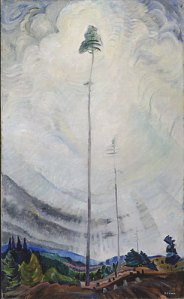
Emily Carr was one of BC’s first “environmentalists”, showing in her art both the beauty of the forest, and the destruction wrought by forestry. There is a large collection of Emily Carr at Vancouver Art Gallery. Give your students a large sheet of watercolour paper (or regular paper if watercolour is too expensive) and a limited period of time (15 minutes?) To create an “interpretation” of an Emily Carr painting. This one is usually called Lone Pine.
True and Yet Not True?
First, show the students the images in the book and ask them to talk about how old Jadav is, how much life his 40 acres can support, whether he was ever employed, and how he makes a living. Second, give the students articles about the real story that this book is based on. Get students to discuss:
- Is it OK that the story isn’t exactly precisely true, even though he is the actual person who did create a forest on his own and has certainly dedicated his life to doing it for no money?
- Why would the author take liberties with the story?
- Would the story be just as interesting and just as inspiring for young people if it were “factual”? What parts make it inspiring?
For more creative writing ideas, click The Boy Who Grew a Forest to download.
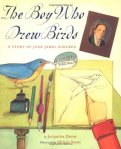 James Audubon was French, and was sent to America to learn business, and also to avoid French military service in Napoleon’s army. While there, he became passionate about the observation and detailed paintings of birds. This is his story with particular emphasis on his “test” of migration.
 Naturalists study nature the way it is rather than the way theories say it is. As a result, going back to Aristotle, there has been steady progress in science because of the work of naturalists. The attached pages describe 17 naturalists and their contributions to the study of the real world. This can be a great Rapid Research project to build general knowledge about history (useful as well in building vocabulary), speaking and writing skills, and, of course, research skills.
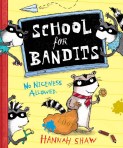 Ralph Raccoon is too polite and too nice. His parents have to send him to Bandit School to learn to be a proper bad raccoon. How does Ralph use his “niceness” to succeed?
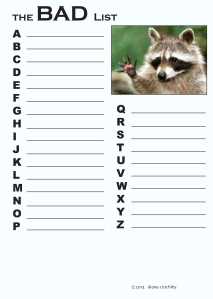 The Being Bad Alphabet
 Diana Cruchley