
Earle Dickson’s wife Josephine has many kitchen injuries – cuts, burns, and scrapes. To help her Earle creates a cover to protect the injury that eventually becomes Band-Aid by Johnson and Johnson. Johnson and Johnson develops a market by providing them free to the Boy Scouts.
Barry Wittenstein, ©2018, Charlesbridge, 978-1-58089-745-7
Writing: Playing with the Structure
The most fun of this book is the series of endings—six times in the course of the book when a logical pause in the plot occurs, the author says “The End.” But when the page is turned over the plot continues! Phrases that restart the plot are “Actually, that was just the beginning,” “But WAIT,” “Oops, not yet,” “Sorry, not really.”
Students could start by writing a story, following the basic story plot of a problem, with three attempts to solve it, before succeeding. When the draft is finished, they could enlarge and expand it, by adding details of conversation, and including “The End” at each of the attempts to solve it then continuing on the next page with why that solution does not work.
Because of COVID-19
We have discovered during the pandemic, many adults don’t seem understand what a vaccination is and does. We attribute it often to the fact that in their lifetime and even their parent’s lifetime, they did not experience or see anyone who caught the many diseases that vaccination prevents. They have not experienced polio, measles, mumps, rubella, small pox, etc. and don’t know anyone who did. There’s a meme going around saying:
“Remember when you caught polio?”
“Of course you don’t. Your parents vaccinated you.”
So, if you did a small presentation about how vaccines work first, you could then assign pairs of students to study the 15 diseases for which we have vaccines—all developed since about 1920. If each pair took one disease, they could present on the following topics:
- What is the disease and its effects?
- How many people used to catch it?
- How many people suffer long term effects from it or die?
- Who developed the vaccine and when, and how?
Students could prepare a collective report—each pair preparing a two-page presentation with images. That project could be bound and catalogued for the library. Then students could prepare an oral presentation for their disease to help developing speaking skills.
Possibilities include:
- Insulin
- Tuberculosis
- Diphtheria
- Tetanus (lock jaw)
- Pertussis – whooping cough
- Penicillin (great antibiotic, not a vaccine)
- Yellow Fever
- Smallpox
- Shingles
- Measles
- Mumps
- Hepatitis A and B
- Polio
- Chicken Pox
- (You could include the COVID-19 vaccines if you like)
My Personal Timeline: Writing
The back of the book has a timeline for the major events of Earle Dickson’s life with a focus on his career with Johnson and Johnson. It might be an interesting project for students to write their own timeline, starting from their birth, kindergarten, grade one, etc. and also including any major events in each year.
For more creative writing ideas, click The Boo-Boos that Changed the World to download.
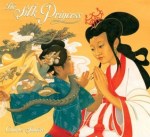 Hsi-Ling Chi is the daughter of the Emperor and is rarely noticed. The Emperor has been seeking for a cloth worthy of his nobility. One day, Hsi-Ling Chi notices a cocoon has fallen in her mother’s tea and is unraveling. They play a game to see how long it is and the little girl ties it around her waist. She goes out past the stone garden, past the spider, outside the palace, to the holy mountains where a dragon threatens her. Along the way she loses the thread, but meets a hermit who shows her how the silk can be woven, and offers to take her home. She falls asleep, wakens to no silk cloth but still with the silk thread tied around her waist—the whole thing was a dream. When she gets back her mother hears her story and thinks, “Hmm? Is this possible?” She summons the royal weavers and the rest is history.
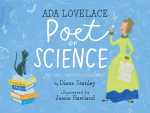 The story of how 200 years ago, the daughter of Lord and Lady Byron, Ada Lovelace, wrote the first program—before there was electricity to make it work. Working with Thomas Babbage on the Analytical Engine, she wrote step-by-step how Bernoulli numbers could be coded for the machine.

 The story of Marco Polo and his trip from Venice to Beijing starting in 1271 and his return 24 years later. The illustrations are in an eastern 13th century style, with gilding and gorgeous elaborate borders all using Chinese inks. Be selective in your choices of what you read – it is a long picture book.
 Diana Cruchley