
Earle Dickson’s wife Josephine has many kitchen injuries – cuts, burns, and scrapes. To help her Earle creates a cover to protect the injury that eventually becomes Band-Aid by Johnson and Johnson. Johnson and Johnson develops a market by providing them free to the Boy Scouts.
Barry Wittenstein, ©2018, Charlesbridge, 978-1-58089-745-7
Writing: Playing with the Structure
The most fun of this book is the series of endings—six times in the course of the book when a logical pause in the plot occurs, the author says “The End.” But when the page is turned over the plot continues! Phrases that restart the plot are “Actually, that was just the beginning,” “But WAIT,” “Oops, not yet,” “Sorry, not really.”
Students could start by writing a story, following the basic story plot of a problem, with three attempts to solve it, before succeeding. When the draft is finished, they could enlarge and expand it, by adding details of conversation, and including “The End” at each of the attempts to solve it then continuing on the next page with why that solution does not work.
Because of COVID-19
We have discovered during the pandemic, many adults don’t seem understand what a vaccination is and does. We attribute it often to the fact that in their lifetime and even their parent’s lifetime, they did not experience or see anyone who caught the many diseases that vaccination prevents. They have not experienced polio, measles, mumps, rubella, small pox, etc. and don’t know anyone who did. There’s a meme going around saying:
“Remember when you caught polio?”
“Of course you don’t. Your parents vaccinated you.”
So, if you did a small presentation about how vaccines work first, you could then assign pairs of students to study the 15 diseases for which we have vaccines—all developed since about 1920. If each pair took one disease, they could present on the following topics:
- What is the disease and its effects?
- How many people used to catch it?
- How many people suffer long term effects from it or die?
- Who developed the vaccine and when, and how?
Students could prepare a collective report—each pair preparing a two-page presentation with images. That project could be bound and catalogued for the library. Then students could prepare an oral presentation for their disease to help developing speaking skills.
Possibilities include:
- Insulin
- Tuberculosis
- Diphtheria
- Tetanus (lock jaw)
- Pertussis – whooping cough
- Penicillin (great antibiotic, not a vaccine)
- Yellow Fever
- Smallpox
- Shingles
- Measles
- Mumps
- Hepatitis A and B
- Polio
- Chicken Pox
- (You could include the COVID-19 vaccines if you like)
My Personal Timeline: Writing
The back of the book has a timeline for the major events of Earle Dickson’s life with a focus on his career with Johnson and Johnson. It might be an interesting project for students to write their own timeline, starting from their birth, kindergarten, grade one, etc. and also including any major events in each year.
For more creative writing ideas, click The Boo-Boos that Changed the World to download.
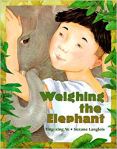 In the mountains of China was a small village living peacefully with their working elephants. They especially liked the baby elephant who would play with the children. The Emperor demanded the baby elephant but it refused to play with the Emperor’s children. The Emperor determined to put him death, but first posed an absurd riddle—whoever could weigh the elephant could win it. A little boy in the village solved the problem (by using displacement) and the baby elephant returned home.

 The story of Marco Polo and his trip from Venice to Beijing starting in 1271 and his return 24 years later. The illustrations are in an eastern 13th century style, with gilding and gorgeous elaborate borders all using Chinese inks. Be selective in your choices of what you read – it is a long picture book.
 Gabe is a hockey player whose lucky number is 22, the same number as her hero, Hayley Wickenheiser. But her new jersey is #9. She is crushed. Gabe’s grandmother explains that the #9 was the retired number of Rocket Richard, Gordie Howe, bobby Hull, etc. and that #99 was Gretsky’s number. Gabe is reconciled, and dreams of her own retired #9.
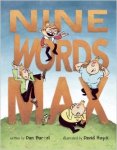 Max is very verbal, and his two brothers are not. Tired of his constant chatter, they obtain a wizard whose spell limits Max to 9 words. This works well for the brothers, until Queen Spark, of the land of Flint, who must be treated in a very specific way that only Max knows, visits them. Without his knowledge, war may erupt.
 A pair of students have an assignment to create and tell a fairy tale to the class and are in serious dispute as to the direction the plot will take. The girl wants it traditional; the boy wants it cool.
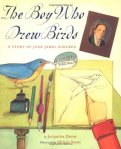 James Audubon was French, and was sent to America to learn business, and also to avoid French military service in Napoleon’s army. While there, he became passionate about the observation and detailed paintings of birds. This is his story with particular emphasis on his “test” of migration.
 Naturalists study nature the way it is rather than the way theories say it is. As a result, going back to Aristotle, there has been steady progress in science because of the work of naturalists. The attached pages describe 17 naturalists and their contributions to the study of the real world. This can be a great Rapid Research project to build general knowledge about history (useful as well in building vocabulary), speaking and writing skills, and, of course, research skills.
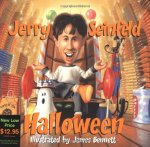 This is a picture book version of Jerry Seinfeld’s wonderful routine on what Halloween was like to him as a child.
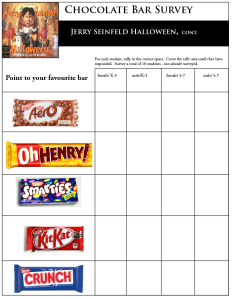 The Candy Vote
 Latitude and Longitude are just imaginary lines on the surface of the earth, but are critical to navigation. Latitude (north and south) was known, but it wasn’t until John Harrison (a clockmaker) tackled it in the 1700’s in order to win a prize, that the problem was solved.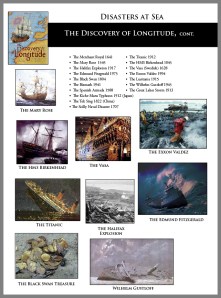
 Diana Cruchley