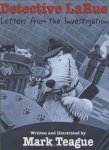
The follow-up book to Dear Mrs. LaRue, using the same pattern, finds Ike accused of abducting the neighbour’s cats. Mrs. LaRue is on vacation, and the story proceeds through his letters from jail, and on the road, as he tracks down the culprits. As with the other book, his letters in black and white show the difficulties he is claiming to have; the coloured pictures show the reality of his experience.
Mark Teague, Scholastic, ©2004, ISBN 0- 439-45868-4
The Letter Story
This book can provide an excellent model for telling a story that advances through a series of letters. Ask students to first outline a story they wish to write, then to add rich details in the form of a series of letters home, or to a friend, or someone who has moved a way, telling a bit of the story in each letter.
The Point of View Story

Each page of the book contrasts black and white with colour. The black and white portion of the picture represents how Ike is seeing the situation. In the first letter he is seeing himself as sitting in a bare cell, singing with a rat, with a metal tin, presumably having held food on the floor, looking pathetic. In the colour picture, he is sitting at the officer’s desk, with dog bones and a doughnut, drinking a coffee the officer has presumably poured, while typing his letter on the officer’s typewriter.
This is an excellent model for two perspectives on any historic Social Studies event being studied. For example, on one side of the page of a report on Columbus, students could write the historic story of Columbus. On the other side, the same story from the point of view of the miserable sailor who is suffering from sea sickness, shortage of food, scummy water, scurvy, crowded conditions, etc.
Did you know, for example, that the three ships of Columbus were actually the Nina, the Pinta, and the Navidad. Apparently, on Christmas the crew was drunkenly celebrating and a sailor ran the Santa Maria aground. They built a new ship from scavenging the old one, and anything else they could find and christened it The Navidad (for the name of Christmas in Spanish.) It would make a great letter.
YouTube Reading Rockets
An interview with Mark Teague about his early writing experiences is available at YouTube Reading Rockets where he describes dictating stories to his mom. It’s very short…and might make a really good prompt to students writing a journal entry about their earliest writing experiences.
For 10 creative writing ideas, click Detective LaRue 2pdf to download.
 The story of Marco Polo and his trip from Venice to Beijing starting in 1271 and his return 24 years later. The illustrations are in an eastern 13th century style, with gilding and gorgeous elaborate borders all using Chinese inks. Be selective in your choices of what you read – it is a long picture book.
 Wabi Sabi, the cat, goes on a journey to find the meaning of her name. She asks a cat friend, a dog, a bird, and finally a monkey. Each says, “That’s hard to explain”—the catch phrase of the book. Slowly she discovers that it is a kind of humble beauty, you will be exploring with student.
 A great chief of the Pacific Northwest is creating his totem. The animals (beaver, bear, wolf, owl, eagle, frog, killer whale, otter, thunder, and raven) each present a quality that the chief might have that would lend itself to creating his totem. Each tries to persuade him to include them.
 Night Flight has few words. It concentrates on just 14 hours and 56 minutes of time, starting in the evening from Harbour Grace in Newfoundland on May 20th, 1932, and ending in Ireland. The author recreates the experience in vivid descriptive language of what she had to do to stay awake, storms, failure of equipment, flying through the night. The author also describes what is seen from the plane as she left, during the night, flying over tundra, approaching land in Ireland. Imagine the Irish farmer coming toward this strange vehicle that had landed in his field, and the woman waving and saying, “I’ve come from America.” Amazing.
 James advises his younger brother on the 10 things you must not do if you ride the school bus. They range from not sitting at the front, not sitting at the back, not making eye contact with the bully, to not touching the bully’s stuff, not sitting with a girl, and finally to not talking to the bus driver. During the course of the day, his brother inadvertently breaks all 10. But he discovers that things work out and makes a rule 11—you don’t have to pay attention to the rules.
 Diana Cruchley