 Written in the first person, a boy tells of his simple day. First he describes the setting by the sea with a house, a road, a grassy cliff, the sea, and the town and his father digging coal under the sea. Then getting up, going to the playground, having lunch, doing an errand in town, visiting his grandfather’s graveyard and and going home, listening to the radio, having dinner, An ordinary day, and at every stage he thinks of his father digging coal under the sea.
Joanne Schwartz, ©2017, Groundwood Books, 978-1-55498-871-6
A First Person Story of Your Day
Using the story as a model, students could write a simple story of what happens during a typical day in their life. They could then mark 5 places where they will place sentences, “And my mother”….. followed by “and my father.” They may need to consult with their parents to find 5 things that they typically do throughout a day. Putting these things together will show the three lives happening separately but at the same time of the day. It could be a rather powerful little piece of writing.
Mining Songs
In Canada, the song Working Man, sung by Rita MacNeil, is considered a classic. It is also a perfect representation of the life of the men of Town Is By the Sea.
The Power of Repetition
At each point in the story, our narrator repeats that his father is a miner and that he digs for coal under the sea; this is repeated 5 times. Before that statement, each time, there is a description of the state of the sea—its white tips, its sparkle, its crash, its calm quiet, the sun sinking into it, the sound as you fall asleep. Under that sea is where his father digs coal.
Ask students to listen for the repetition—half of them listening for the description of what his father is doing, and half for the mention of the sea. They could make a quick note of each one, or they could just count how many times it happens.
For 11 teaching ideas, click Town is By The Sea to download.

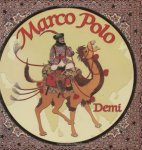 The story of Marco Polo and his trip from Venice to Beijing starting in 1271 and his return 24 years later. The illustrations are in an eastern 13th century style, with gilding and gorgeous elaborate borders all using Chinese inks. Be selective in your choices of what you read – it is a long picture book.
 Mr. Mutt is the Ann Landers of dogs. Six dogs write in with their problems, and receive answers from Mr. Mutt, along with critiques from The Queen (a cat with a point of view. Answers are accompanied by cute graphs, useful for teaching graphing to students. It also closes with two newspaper articles as the cats attack Mr. Mutt.
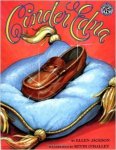 Cinder Edna is the liberated neighbour of Cinderella. Cinderella needs a fairy godmother to get her to the ball; Cinder Edna earns money mowing lawns and cleaning parrot cages. She earns enough for the dress, wears comfortable loafers to the ball, and takes the bus. She gets the best prince too—the brother of the one Cinderella marries.
 How Gutenberg Changed the World. Illustrated like a medieval manuscript, the book shows how all the parts of the process came together to create the first printing press.
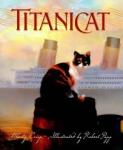 Jim is a cabin boy on the Titanic assigned to watch over a cat and her kittens. He sees the cat taking her kittens off the ship before it sails. As the “All ashore” is called there is one last kitten, so Jim takes it off and misses the ship. Based on a true story.
 Fibonacci was part of the revolutionary change from Roman numerals to Arabic numerals in the 12th century. His most important contribution to math is the Fibonacci sequence, which this book explains.
 Astonishingly, nature uses these numbers all the time…in flower petals, seeds inside, starfish, 3 leaf clovers, 8 sections in a lemon, etc. Even humans have 1 head, 2 eyes, 5 fingers, etc.
 Diana Cruchley