 Wabi Sabi, the cat, goes on a journey to find the meaning of her name. She asks a cat friend, a dog, a bird, and finally a monkey. Each says, “That’s hard to explain”—the catch phrase of the book. Slowly she discovers that it is a kind of humble beauty, you will be exploring with student.
Mark Reibstein, Little Brown, © 2008, 9789-0-316-11825-5
Extreme Writing
A springboard from a picture book to personal writing should provide at least three topics if possible. Here are some ideas:
- Wabi Sabi wants to know what his name means. What does your name mean? Tell a story about how you got your name(s), or nickname.
- Wabi Sabi goes on a journey to find the answer to her question. Write about any journeys you have been on.
- This story is set in Japan. Either write “Everything I know about Japan” or “Everything I know about Canada, B.C., or my home town.”
- Wabi Sabi asks for an explanation. Explain how to do a few things that were hard for you to do at first.
The Author
There is a nice YouTube video of how Mark Reibstein came to write the book based on what he learned about Wabi-sabi while teaching in Japan, and his adoption of his cat. Then Ed Young explains how he illustrated it, how the illustrations were actually lost or stolen, and how he came to use ordinary materials to create the next version. Rather nice.
Incidental Geography
Three Japanese locations are mentioned as Wabi Sabi conducts his search for the meaning of his name: Tokyo, Mount Hiei, and Ginkakuji. Put them on a simple map of Japan. Ask the students to think about how to calculate the distance of the journey, round trip from Tokyo to Mount Hiei to Ginkakuji and back to Tokyo. The fastest way will be Google. Just search “Distance from Tokyo to Mount Hiei” etc. and add the numbers which will turn out to be over 900 km—a long distance for a cat.
For 9 creative writing ideas, click Wabi Sabi to download.
 The Big Bad Wolf explains that he used to be a handyman for Grandma and that Little Red Riding Hood always ignored him. On the day Little Red Riding Hood came, Grandma was accidentally knocked unconscious in the wardrobe and everything went from bad to worse from there. All he wants is a new job with someone else.
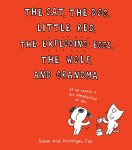 The Cat tries to tell the Little Red Riding Hood story while the Dog, who loves superheroes, criticizes, adds his own thoughts, and questions the morality of the story. Lots of fun…very post-modern.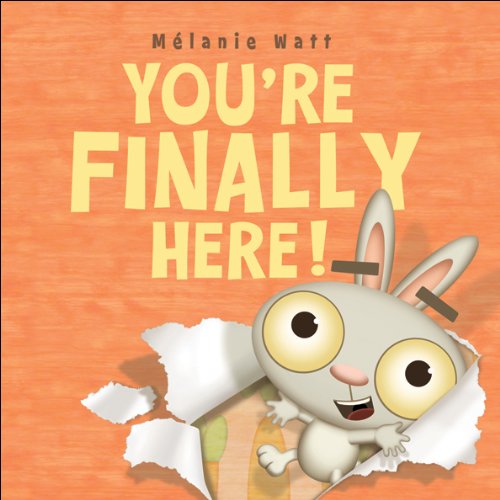
 The ant is invited to the lion’s dinner party and is shocked at the manners of the other guests as they greedily “share” the cake. When she herself is accused of being greedy, the ant turns the tables on the other guests.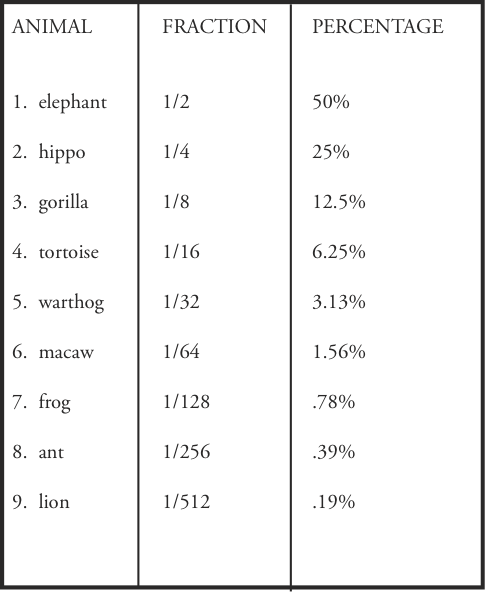
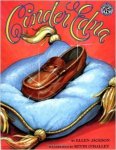 Cinder Edna is the liberated neighbour of Cinderella. Cinderella needs a fairy godmother to get her to the ball; Cinder Edna earns money mowing lawns and cleaning parrot cages. She earns enough for the dress, wears comfortable loafers to the ball, and takes the bus. She gets the best prince too—the brother of the one Cinderella marries.
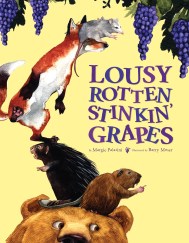 In this twist on Aesop, the fox progressively involves a series of animals in an elaborate plan to help him get the grapes. He refuses to listen to their advice, and when his plan fails, he leaves saying the grapes are probably not ripe. After he leaves, the other animals get the grapes.
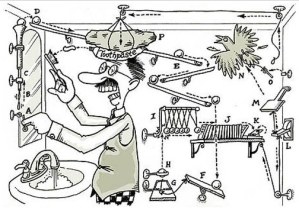 Our fox makes somewhat of a “Rube Goldberg” plan, each part of which is more elaborate than next, and requiring ever more complicated diagrams. The original model of a plan that is too elaborate is named after Rube Goldberg. The illustration is of a machine to brush your teeth. Ask students to create a “Rube Goldberg” plan to do something simple like wash a car, or sharpen a pencil.
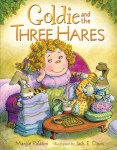 The Hare family is having dinner when Goldilocks, fleeing from the three bears, falls down the hole. Having hurt her foot, she remains as a guest, but is a terrible one. How can the Hare family get rid of her?
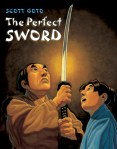 Masa and his apprentice Michio make a “perfect sword” and then seek the person worthy of it. Each candidate is rejected as they hear from the warrior, the swordsman, the noble, and so on. They need someone kind, who doesn’t automatically reach for a sword to solve problems, who wants to help others, and who is noble. Like a fairy tale, but this one takes FOUR tries, they eventually find the right candidate. Satisfied, they turn to making the next “perfect sword.”
 Diana Cruchley