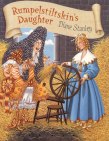
 This fractured fairy tale begins after “Meredith” marries Rumpelstiltskin instead of the king and they have a daughter, Hope. Occasionally Rumpelstiltskin spins some gold and Hope takes it to the village. On hearing of it, the king captures her and demands she spin gold. She says she is not sure, but believes her grandfather did it with wheat. So it is planted across the kingdom. The peasants are happy, but the king still wants gold. Next, they try gold wool—again, the peasants are happy, but the king wants gold. Eventually, Hope becomes Prime Minister and, whenever the king becomes anxious, she takes him on a goodwill tour of his now happy kingdom.
Diane Stanley, ©1997, Harper Collins, ISBN 0-688-14327 – X
Parodies of Art
On the wall in the king’s castle are several clever parodies of some famous paintings. Since awareness of famous art and artists is part of the art curriculum, a study of the 8 pictures that are easily identified could be fun. Give each group of students a photocopy of one of the parodies from the book. Then give them a photocopy of the original piece of art, its name, and artist.
Ask students to prepare a one page “poster” on their picture. The poster would include both illustrations along with several paragraphs on the artist’s life, and a paragraph on the piece of art. Why was it created, when, for whom, where it is now, what is it a picture of, etc.?
Explain that an art reference “joke” like this is a literary reference—it is hard to get the joke without background knowledge. You can even talk about how there are a lot of “in jokes” that young people would not get in a movie like Shrek, but that adolescents and adults have background knowledge to catch the reference.
The pictures in the book are:
- Mona Lisa, Leonardo da Vinci
- Birth if Venus, Botticelli
- Laughing Cavalier, Frans Hals
- Starry Night, Vincent Van Gogh
- Seated Woman with a Wrist Watch, Pablo Picasso
- George Washington, John Trumbell
- Whistler’s Mother, James McNeil Whistler
- Frederico de Montefeltro, Piero della Francesca
Compare the Tales
Working in pairs, ask students to generate the longest possible list of the characteristics the three stories they have in common—the original Rumpelstiltskin’s fairy tale, the version where Meredith marries Rumpelstiltskin instead of the ing, and the story of her daughter Hope. They should find at least the following qualities:
- Rumpelstiltskin
- Meredith
- The King
- The request to spin gold
- The threat of death
- The promise of marriage
- Three tries
- The palace
Students can also be asked to write their comparison when they have completed their list.
For 6 creative writing ideas, click Rumpelstiltskin’s Daughter to download.
 A wonderful retelling of the Aesop fable where the fox makes frequent attempts to get at the grapes until he finally says that they are probably sour anyway. Hence the expression “sour grapes”.
 Diana Cruchley