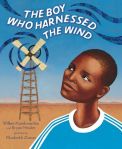
 The true story of a boy living in Malawi who created a windmill to generate electricity and pump water for his village.
William Kamkwamba, Penguin, ©2012, 978-0-8037-3511-8
Science of Corn
As a science study, you could bring in jeweller’s loupes and enough corn so that each pair of students can have a slice. Use the loupes to have students ask themselves, “What does this look like? What does it remind me of?” They should think of 5-10. Some examples are:
- tiny pats of butter
- little yellow pillows
- coated pills
- colourful pool toys
- little balloons
The science question is, “If it looks like a tiny pat of butter, is there any way it could act like a tiny pat of butter?” Of course, corn oil, is very high calorie and often used as a replacement for butter, so that isn’t too hard.
What about “If it looks like a little yellow pillow, is there any way it could be acting like a little yellow pillow?”
A good Inquiry series of questions can come out of these, and often a little experiment can be constructed to test whether it is indeed acting like what it looks like. For example, could we extract a kernel carefully and see if it floats, like a pool toy?
Remind students that 95% of nature is function over form. That is, it doesn’t look beautiful just to look beautiful; there is a reason for it.
An Inquiry into Crops of the Americas
Historically, corn was one of the North American crops exported around the world, so it is interesting that it is the major crop of Malawai. Students may be interested in investigating what other foods originated in the Americas, including chocolate, tobacco, potatoes, vanilla, tomatoes, peanuts, avocado, chili peppers, papaya, pineapple, maple syrup, sunflower, wild rice, turkey, cranberry, sweet potato, quinoa, brazil nuts, cashews.
Art
The Internet has lessons for how to draw nearly anything—in this case, an ear of corn. You could start students with a cartoon corn:
Followed by a more sophisticated drawing:
For 9 creative writing ideas, click The Boy Who Harnessed the Wind to download.
 Max is very verbal, and his two brothers are not. Tired of his constant chatter, they obtain a wizard whose spell limits Max to 9 words. This works well for the brothers, until Queen Spark, of the land of Flint, who must be treated in a very specific way that only Max knows, visits them. Without his knowledge, war may erupt.
 A delightful ABC book of circus anecdotes principally focusing on the most famous acts of Barnum and Bailey. It is all done in the style of the big circus posters of the 30’s advertising the next circus to come to town. Visually gorgeous.
 Wabi Sabi, the cat, goes on a journey to find the meaning of her name. She asks a cat friend, a dog, a bird, and finally a monkey. Each says, “That’s hard to explain”—the catch phrase of the book. Slowly she discovers that it is a kind of humble beauty, you will be exploring with student.
 The Big Bad Wolf explains that he used to be a handyman for Grandma and that Little Red Riding Hood always ignored him. On the day Little Red Riding Hood came, Grandma was accidentally knocked unconscious in the wardrobe and everything went from bad to worse from there. All he wants is a new job with someone else.
 The Cat tries to tell the Little Red Riding Hood story while the Dog, who loves superheroes, criticizes, adds his own thoughts, and questions the morality of the story. Lots of fun…very post-modern.
 A pair of students have an assignment to create and tell a fairy tale to the class and are in serious dispute as to the direction the plot will take. The girl wants it traditional; the boy wants it cool.
 Mr. Mutt is the Ann Landers of dogs. Six dogs write in with their problems, and receive answers from Mr. Mutt, along with critiques from The Queen (a cat with a point of view. Answers are accompanied by cute graphs, useful for teaching graphing to students. It also closes with two newspaper articles as the cats attack Mr. Mutt.
 Mr. Button buys a dog; Mrs. Button buys a cat. The two have conflicting habits and fight constantly until their owners bring home – a baby. The problem is solved when the cat and dog reconcile and build a home for themselves in the backyard.
 Diana Cruchley