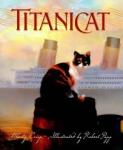
Titanicat

Titanicat CoverJim is a cabin boy on the Titanic assigned to watch over a cat and her kittens. He sees the cat taking her kittens off the ship before it sails. As the “All ashore” is called there is one last kitten, so Jim takes it off and misses the ship. Based on a true story.

Marty Crisp, Scholastic, ©2008, ISBN 978-0-545-2880-2

Superstitions

Our cabin boy is saved from the Titanic because of the superstition that a cat leaving a ship is a sign of disaster. Show students the pictures on the Titanicat Superstitions PDF and have them describe what the luck is that the image is conveying (good or bad).

Cat Breeds

The ship’s cat is a tortoiseshell cat. This might be a good time to introduce students to the names and vocabulary of cat breeds, some of which are:

  • Ragdoll
  • Maine or coon cat
  • Bengal
  • Siamese
  • Manx
  • Persian
  • Abyssinian
  • Angora
  • Russian blue

For 10 creative writing ideas, click Titanicat to download.
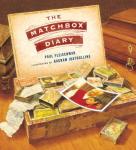
The Matchbox Diary

15798648Grandfather has a room full of treasures, each with a story attached. She asks for the story of the cigar box filed with matchbooks, each with a tiny symbol of a story from grandfather’s life.

Paul Fleischman, Candlewick, ©2013, ISBN 978-0-7636-4601-1

Mining a Picture

In one of the matchboxes is a picture of grandfather’s father. The author writes 151 words about that photo – and this is in a picture book where words are at a premium. Ask students to bring a picture to class. You could then show how you can “mine a picture” to write.

  1. When was this photo taken? Why do you think it was taken?
  2. Who is the person in the picture? Why is the person in that pose?
  3. Who took the picture? Talk about the picture taker.
  4. What is being worn in the picture? Talk about the clothes.
  5. What other things are in the picture?
  6. What is the mood of the picture?
  7. What smells, sights, sounds, do you associate with the picture?


Now students have enough to easily write about 200 words about the photo.

Making Small Boxes

This story uses as a “prop” a matchbox. The House Baba Built, by Ed Young, mentions that the children would gather silkworms and put them in little origami boxes that they built, and feed them mulberry leaves. There are many YouTube videos of simple instructions for making your own origami boxes. This is the easiest one that I found.

To make the “inside” of the box – just take about .5 cm off two sides of the square to make a smaller square.

For 10 creative writing ideas, click The Matchbox Diary to download.

The Librarian Who Measured the Earth

librarian-who-measured-cover jpgThe biography of the ancient Greek mathematician and librarian who measured the circumference of the earth, with an error of only 200 miles, at a time when people didn’t even know for sure the earth was round, using math alone.
Kathy Lasky, Little Brown and co., ©2004, ISBN 0-316-51526-4

Ancient Libraries

The Library at Alexandria was the greatest library on earth for over 1000 years. There were over 700,000 rolls of papyrus in their collection of “books.” You couldn’t take a book out, so a librarian would help you find the scroll you had in mind.

For Rapid Research (click for PDF) it would be great for students to find out everything they can about the following libraries or book collections and write their own “book” of 200-400 words:

  1. The Library at Alexandria
  2. The House of Wisdom
  3. The Library at Ephesus
  4. The Library at Constantinople
  5. The Burning of the Mayan Books
  6. Hitler’s Book Burning
  7. The Cordoba Library – Library of Al-Hakam III


Look Like a Math Genius – The 11 X Table

Teach students how to multiply a two-digit number, in their head, faster than a calculator.

43 x 11 = ???

Answer:

  • The first number is 4
  • The last number is 3
  • The middle is their sum = 7
  • The answer is 473

Tell them to say it slowly, to impress their friends.

For 8 creative writing ideas, click The Librarian who Measured the Earth to download.

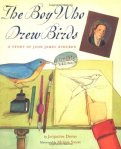
The Boy Who Drew Birds

boywhodrewbirdsJames Audubon was French, and was sent to America to learn business, and also to avoid French military service in Napoleon’s army. While there, he became passionate about the observation and detailed paintings of birds. This is his story with particular emphasis on his “test” of migration.

Jacqueline Davies, Houghton Mifflin, ©2004, ISBN 0-618-24343-7

Audubon Art

First, students need to watch a YouTube on drawing birds. The one I liked best, is a little “cartoon-like” but it is fast, and clear and could be adapted to more “realistic drawings.

Next, provide a set of Audubon style drawings for students to “observe”. Ask them to draw just one of the birds. They should sketch in pencil, and then go over it when adding details, using ink. Finally they would erase the original pencil, and finish with coloured crayons or felts.

Tell them not to worry because when the original inspiration is taken away, their drawing will look really good. (A lot of students think that “real drawing” needs to be done from your head. No. All great artists had models, observed from nature; or now they start with a photo.)

If students draw on a piece of paper around 3 X 5 inches, it can be turned into a very nice card for Mother or Father’s Day.

Famous Naturalists Vimeo

Click The Great Naturalists to watch a video for the University of Idaho about some of the most famous naturalists.

Famous Naturalists – Rapid Research

List of Famous NaturalistsNaturalists study nature the way it is rather than the way theories say it is. As a result, going back to Aristotle, there has been steady progress in science because of the work of naturalists. The attached pages describe 17 naturalists and their contributions to the study of the real world. This can be a great Rapid Research project to build general knowledge about history (useful as well in building vocabulary), speaking and writing skills, and, of course, research skills.

Working in pairs, students must find 20 facts about their naturalists and present a list of 20 complete sentences describing what they have found. There are then several options:

  • Students each write their own essay describing what they have found out, which is marked, then mounted on cardstock and illustrated from the Internet for a very effective classroom display of student work.
  • Finished essays can be submitted with a literal question and an answer from the book. Once the finished essay is mounted, the question is added and the answer form part of a key on your desk. The cardstock items are numbered in 72 point numbers, and then students circulate to find 5 answers from the pages. They may go in pairs, but only one pair may be at a station at a time in this Scavenger Hunt.
  • The illustrations for the naturalists can be quickly placed by you into a Keynote or PowerPoint presentation and students, again in pairs, have each 1 minute (2 minutes in total) to present their information. This is the one most likely to increase general knowledge in students.

For 7 creative writing ideas, click The Boy Who Drew Birds to download.

Miss Hunnicutt’s Hat

61VXWEWPH0LThe Queen is coming to Littleton and Miss Hunnicutt wants to wear her hat with a chicken on top. After she stands up for her right to wear what she wants, we discover that the Queen loves her hat with the turkey on top.

Jeff Brumbeau, Orchard Books/ Scholastic, ©2003, ISBN 0-439-31895-5

The Art of Hats

Many famous pieces of art involve women wearing hats. Attached are a couple of pages of samples of such pieces of art, with their name, and the artist.

hatsinartAsk students to choose one to research (in pairs). The team needs to produce 12 facts about the artist, and 6 facts about the painting (where it is located, size, and, the model, the hat, etc.)

Depending on the time you have students may:

  • Report on an 8.5 X 11 poster with the picture and their information
  • Report orally (2 minutes. 1 minute each) as you show the images on a screen.
  • Create a scavenger hunt to expose them to at least 5 of the poster reports.

Follow the Pattern

Students can incorporate their own pattern into a story that they create. Each time Miss Hunnicutt is asked to take off her hat she replies:

  1. I will not.
  2. I have a right to wear what I like.
  3. I won’t wear a (flounder) and I won’t wear (an orangutan).
  4. But I will wear (a chicken) and I will wear it on my head.


Student patterns can be either about wearing something, or can be about something they commonly do, such as ride a bicycle.

  1. I will not.
  2. I have a right to ride a bicycle.
  3. I won’t ride in the ditch, and I won’t ride in the store.
  4. But I will ride in the bike lane, and I’ll do it in the morning.


For 10 creative writing ideas, click Miss Hunnicut’s Hat to download.

Jerry Seinfeld Halloween

Jerry Seinfeld Halloween, coverThis is a picture book version of Jerry Seinfeld’s wonderful routine on what Halloween was like to him as a child.
Jerry Seinfeld, Little Brown, ©2002, ISBN 0-316-70625-6

The Candy Forced Choice

Create four signs – Strongly Agree, Strongly Disagree, Agree, Disagree. Tape on the four walls of the class. Ask a series of candy related questions and have students pre-decide before going and standing under the sign for their opinion. Students under that sign should first discuss their opinion with a partner. Then you conduct a class discussion.

Ask the students in the AGREE or DISAGREE categories first – students tend to gravitate there thinking they may avoid talking – and since this is oral language, we want everyone “in” the game.

Possible questions:

  1. Candy is better than peanuts.
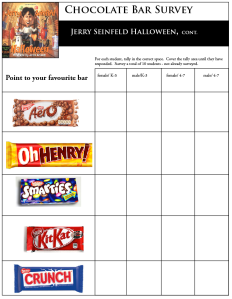
  2. O’Henry is better than Smarties.
  3. Children should not be given any candy under the age of 4.
  4. Parents whose children have cavities are abusive and should be fined.
  5. If there is no real chocolate in the bar, any words that sound “chocolatey” should not be allowed.
  6. Deciding what to eat is a decision for parents.


Screen Shot 2014-09-29 at 11.51.24 AMThe Candy Vote

Around Halloween is a good time to conduct a survey. Obtain 5 different miniature candies – maybe asking students for suggestions first. Create a large chart with 5 columns, pasting a candy on each one. Explain to students the various factors that can affect a survey. (See the attached pages for an explanation of potential biases, and a possible survey). If conducting the survey, ask students to work in pairs to survey 10 students from other classes. If you have a class of 30 this would mean 150 student surveys. Here is an opportunity to ensure they understand how to calculate a percent from raw numbers. To make it easier, for younger students, ensure that only 100 surveys are conducted…results are then automatically in percentages.

For 7 creative writing ideas, click Seinfeld’s Halloween to download.

Great Art Thefts

Great Art Thefts coverThis little 48 page book, part of the Treasure Hunters series describes several major art thefts since the beginning of the 20th C. The Mona Lisa, many paintings in the Isabella Gardner Museum, Munch’s The Scream, and a painting by Cezanne are all included.

Charlotte Guillain, Raintree, ©2013, 978-1-4109-4958-5

Personal Writing

A springboard from a picture book to personal writing should provide at least three topics if possible. Here are some ideas:

  1. Things you have lost, or have mysteriously disappeared.
  2. Security. Write about security measures you have noticed in your life, or know about. For example, screening Internet use, airport security, video camera surveillance, passports, fingerprints, etc. Opinions?
  3. Stories about your favourite and least favourite art experiences.


Rapid Research – Missing Art

There are hundreds of missing pieces of art that students could study. Attached are 3 pages with many of them. Ask students, working in pairs, to find 10 interesting facts about the artist, 5 interesting facts about the painting, and 5 facts about how the painting came to vanish. Give them a very limited time -this is Rapid Research. They then make a “report” listing their facts and prepare a very short talk – 1 minute each – about their discovery. I have a Pinterest site with pictures of stolen art titled: Great Art Thefts – A Rapid Research Topic.

For 5 creative writing ideas, click Great Art Thefts to download.

The Discovery of Longitude

Longitude coverLatitude and Longitude are just imaginary lines on the surface of the earth, but are critical to navigation. Latitude (north and south) was known, but it wasn’t until John Harrison (a clockmaker) tackled it in the 1700’s in order to win a prize, that the problem was solved.
Joan Marie Galat, Pelican ©2012, 978-1-4556-1637-4

Great Shipwrecks

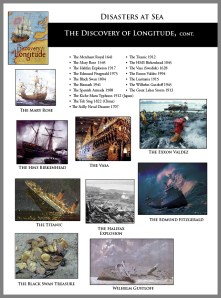
In the 21st century, with GPS and vast improvements in diving equipment, many wrecks are now being found, and even being raised from the sea.

Students could conduct a Rapid Research topic where groups look into 17 famous shipwrecks:

  • The Mary Rose, 1545
  • The Spanish Armada, 1588
  • The Vasa (Swedish), 1628
  • The Merchant Royal, 1641
  • The Scilly Naval Disaster, 1707
  • The Black Swan, 1804
  • The Tek Sing, 1822 (China)
  • The HMS Birkenhead, 1845
  • The Titanic, 1912
  • The Kiche Maru Typhoon, 1912 (Japan)
  • The Great Lakes Storm, 1913
  • The Lusitania, 1915
  • The Halifax Explosion, 1917
  • The Bismarck, 1941
  • The Wilhelm Gustloff, 1945
  • The Edmund Fitzgerald, 1975
  • The Exxon Valdez, 1994

discoverwrecks

Using the Internet, in a limited period of time, students find out:

1. What was this wreck, where was it located, why was it important? When did it happen?

2. What was the impact of this wreck on future navigation if any?

They create a PowerPoint, an essay, a speech, etc. as a group – pooling their research and writing in a “voice” that is aimed at their own grade level.

Careful Listening

Students can be asked to listen very carefully and make note of the PROBLEMS that some of the early solutions to navigation had. Note-taking is one of the critical skills for achievement according to Marzano.

For 7 creative writing ideas, click The Discovery of Longitude to download.

Blockhead – The Life of Fibonacci

BlockheadFibonacci was part of the revolutionary change from Roman numerals to Arabic numerals in the 12th century. His most important contribution to math is the Fibonacci sequence, which this book explains.

Joseph D’Agnesi, Henry Holt, 2010, ISBN 978-0-8050-6305-9

Fibonacci Numbers

If you add any two consecutive numbers in the pattern you get the next number:

  • 1 pair plus 1 pair = 2 pairs
  • 1 pair plus 2 pairs = 3 pairs
  • 2 pairs plus 3 pairs = 5 pairs
  • 3 pairs plus 5 pairs = 8 pairs

The first numbers are 1,2,3,5,8,13,21,55,89,144,233,377.

Pages 26 and 27 explain the Fibonacci numbers…demonstrate to 8 and ask them to continue until they get to 233.

blockheadphotoAstonishingly, nature uses these numbers all the time…in flower petals, seeds inside, starfish, 3 leaf clovers, 8 sections in a lemon, etc. Even humans have 1 head, 2 eyes, 5 fingers, etc.
Roman Numerals

The book mentions that, in Egypt, Fibonacci encountered Arabic Numerals and thought how much simpler they were than his Roman numerals – making it a good time to introduce them. (Actually, the numbers are from India, but the west encountered them in the Arab countries and so called them Arabic numerals.) Lots of sites have activity sheets, but a good site for an explanation is Adrian Bruce’s Maths Stuff. Roman numerals, it reminds us, may be found on watches, old buildings, page numbers in a preface, as subsections in a list on Microsoft Word, titles of kings and queens, periods of Egyptian history, and at the end of Hollywood movies, comics, and games to show the year it was made.

For 8 creative writing ideas, click Blockhead to download.

Wonder Horse

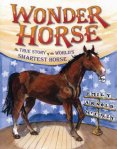
Wonder HorseSubtitled The True Story of the World’s Smartest Horse, this is the story of how Bill Key, former slave, found and trained his horse Jim Key. Unlike other trainers of the time, he used only kindness to teach Jim to recognize the alphabet and colours. They travelled America doing shows, where Bill took the opportunity to teach animal owners the importance of humane treatment. Bill and his horse had a huge influence on the movement leading to the RSPCA.

Emily Arnold McCully, Henry Holt, ©2010, ISBN 978-0-8050-8793-2

Famous Animals – A Rapid Research Topic

Jim Key is the story of both an amazing horse and an amazing owner. Give students a list of famous animals and ask them to prepare a quick research report of about 4 paragraphs (with an illustration if possible from the internet) to make an 11 X 17 poster set of displays for the class.

Working in pairs, students could then make an oral presentation (or a PowerPoint presentation about their particular horses)..length 2 minutes to a maximum length of 5 minutes.

I have created a Pinterest page with 30 amazing animals (horses, dogs, cats) that students can use to start their research (or illustrate it). You can either visit my Pinterest page on my website to view the board (it’s the last one on the page) or visit my Pinterest boards directly (also, don’t forget to follow me on Pinterest!).

Vocabulary

The words students might find difficult are: colic, profile, console, antics, equine, and liniment. This might be a good time to explore vocabulary about horses as a theme. (See page 3 of the attachment.)

For 5 creative writing ideas, click Wonder Horse to download.