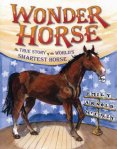
 Subtitled The True Story of the World’s Smartest Horse, this is the story of how Bill Key, former slave, found and trained his horse Jim Key. Unlike other trainers of the time, he used only kindness to teach Jim to recognize the alphabet and colours. They travelled America doing shows, where Bill took the opportunity to teach animal owners the importance of humane treatment. Bill and his horse had a huge influence on the movement leading to the RSPCA.
Emily Arnold McCully, Henry Holt, ©2010, ISBN 978-0-8050-8793-2
Famous Animals – A Rapid Research Topic
Jim Key is the story of both an amazing horse and an amazing owner. Give students a list of famous animals and ask them to prepare a quick research report of about 4 paragraphs (with an illustration if possible from the internet) to make an 11 X 17 poster set of displays for the class.
Working in pairs, students could then make an oral presentation (or a PowerPoint presentation about their particular horses)..length 2 minutes to a maximum length of 5 minutes.
I have created a Pinterest page with 30 amazing animals (horses, dogs, cats) that students can use to start their research (or illustrate it). You can either visit my Pinterest page on my website to view the board (it’s the last one on the page) or visit my Pinterest boards directly (also, don’t forget to follow me on Pinterest!).
Vocabulary
The words students might find difficult are: colic, profile, console, antics, equine, and liniment. This might be a good time to explore vocabulary about horses as a theme. (See page 3 of the attachment.)
For 5 creative writing ideas, click Wonder Horse to download.
 Marvin, is small, skinny, and in competition for the princess with several rude suitors. With the assistance of an an unusual fairy he succeeds in presenting the princess with the three perfect peaches she needs. Unfortunately, rather than giving him his daughter, the kind presents him with challenges including fattening 100 rabbits without losing any of them. Of course he succeeds, with a little magic. An adaptation of a French fairy tale.
 In Japan, the oldest and wealthiest man in the village lives on the hill in his rice farm. In the village below, villagers are getting ready for a festival. Suddenly he senses a problem, and when he sees the waters recede realizes a tsunami is coming. He cannot get down to the village to warn them in time so he needs to draw the villagers to him. As a desperate act, he sets his crop on fire. The villagers rush up the hill to help put out the fire, and they are all saved.
 Masa and his apprentice Michio make a “perfect sword” and then seek the person worthy of it. Each candidate is rejected as they hear from the warrior, the swordsman, the noble, and so on. They need someone kind, who doesn’t automatically reach for a sword to solve problems, who wants to help others, and who is noble. Like a fairy tale, but this one takes FOUR tries, they eventually find the right candidate. Satisfied, they turn to making the next “perfect sword.”
 Cinderella’s Rat is captured in a cage, but is “rescued” by the fairy godmother and becomes the coachman for Cinderella’s trip to the ball. During the ball the coachmen wait, eating in the kitchen. Suddenly, his rat sister appears, looking for him, and to prevent the other coachman from killing him, over hero says she has been enchanted. They take her to a wizard to have her changed back to a girl. The wizard makes several errors and finally creates a girl with the voice of a dog. The happy ending is that the rat’s sister is great at scaring cats away. (More complicated to describe than to read.)
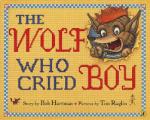 Little Wolf never likes what is made for dinner: Lamburgers, Sloppy Does, Chocolate Moose—nothing pleases him. All he can think about is “boy”—boy chops, baked boy-tatoes and boys -n-berry pie. On the way home to three pig salad, Little Wolf has the idea of pretending to see a boy. After this trick results in him getting junk food for several nights, his father overhears him bragging to a friend. They refuse to listen to him…even though he has seen an entire troop of boy scouts in the woods, and one even enters the cave. Lesson learned, and the boys, at least, live happily ever after.
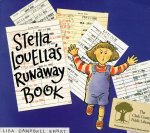 Stella Louella’s is very concerned because today is the day her book is due at the library, and she cannot find it. She traces the book through the neighbourhood. Each person she meets has enjoyed the book, each for a different reason, and passed it on to the next person in the neighbourhood. By the time Stella arrives at the library she has more than 10 neighbours with her.
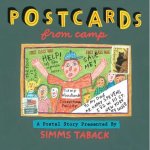 Michael hates camp and informs his father in a series of self-designed postcards of the many trials of his life there. His father returns reassuring postcards until Michael finally comes to love camp.
 Lipman Pike is credited with being the first professional baseball player (then called “base”). This is the story of his childhood, the development of his skills, the aspirations his father had for him, and how he came to be the first “professional” baseball player.
 A great chief of the Pacific Northwest is creating his totem. The animals (beaver, bear, wolf, owl, eagle, frog, killer whale, otter, thunder, and raven) each present a quality that the chief might have that would lend itself to creating his totem. Each tries to persuade him to include them.
 Diana Cruchley