 Gabe is a hockey player whose lucky number is 22, the same number as her hero, Hayley Wickenheiser. But her new jersey is #9. She is crushed. Gabe’s grandmother explains that the #9 was the retired number of Rocket Richard, Gordie Howe, bobby Hull, etc. and that #99 was Gretsky’s number. Gabe is reconciled, and dreams of her own retired #9.
Roy MacGegor, Tundra books, ©2014. 978-1-77049-573
A School Sports Survey
It’s worthwhile setting up an Inquiry about what sports are being played by students in your class, and potentially the whole school. Picture your students out there interviewing fellow students, learning the math of it, thinking about the questions they want answered so that they collect the best information to answer their questions.
Here’s a really simple question they might want an answer to: What are the most common sports played outside of school? Compare males to females and primary students (K-4), intermediate students (5-7), or middle school students (5-9) if that is how you are organized. Students learning percentage calculation can do the math as well for their results. Report results in a school announcement, in a school newsletter, and on your class blog so that they receive the maximum publicity for their results. The School Board may also be interested in knowing the kinds of organized athletic activities students participate in outside of school hours.
Students should first survey their own class, to become familiar with the form, as well as how to tally and use the results. In a single class, if it is a split grade, you can have four categories – male and female for each of the grades. Then, assign them in teams to fan out at recess and lunch and collect results. Teach them polite survey methods: “Will you please help our class with a survey? It will only take a few seconds.” Ask students to read it to students who look like they may have trouble (ESL students, or primary students). Students carry a book to balance the survey on, and a pen to write with. At the end, “Thank you. We’re going to announce the results over the PA.”
A Discussion About Hockey
There are many discussion questions that can arise from this book:
- Why are hockey organizations reluctant to have mixed male and female teams?
- What is our opinion of violence in hockey? Especially now that we are finding that even one concussion can cause permanent brain damage.
- How will global warming effect hockey?
- When the kids say, “Hayley, Number 9” is that bullying? When does teasing cross over into bullying?
- Why are fewer Canadian parents signing their kids up for hockey?
Below are some of the reasons parents give for the decline in the percentage of Canadian youth enrolling in hockey. See what your students think.
Some Reasons Given for the Decline in Hockey Enrollment
- New immigrants from warm countries have little experience of it.
- Warmer winters make it harder to create home-made rink by simply flooding a field.
- The equipment is very expensive.
- Parents do not approve of body checking as it likely to cause brain damage.
- Parents do not want to pay for expensive dental work to repair broken teeth.
- Parents do not like the attitude of “hockey parents.”
- The professional games are too expensive.
- Rink times for less elite players are often at ridiculous times of the day.
- The skill of teams have been diluted by opening up so many franchises.
- Players are being encouraged to actually injure other players.
Hockey Songs
Two hockey songs could be played while using this book:
- The Hockey Song by Jughead
- The Hockey Song by Stompin’ Tom Connors
There are a few others, but these are kid friendly.
For 9 creative writing ideas, click The Highest Number in the World to download.
 Wabi Sabi, the cat, goes on a journey to find the meaning of her name. She asks a cat friend, a dog, a bird, and finally a monkey. Each says, “That’s hard to explain”—the catch phrase of the book. Slowly she discovers that it is a kind of humble beauty, you will be exploring with student.
 A classic Chinese folktale, of a man who owned a horse and at each turn of fate believed that things were neither as good, nor as bad, as they might seem.
 How Gutenberg Changed the World. Illustrated like a medieval manuscript, the book shows how all the parts of the process came together to create the first printing press.
 The author begins by presenting us with his character, Chloe, and asks the illustrator to menace her with a lion. The illustrator thinks it should be a dragon, which starts the quarrel. The illustrator torments the author sufficiently that the author fires him, and, in fact the lion the second illustrator creates eats him. Unfortunately, the second illustrator is really bad and finally Chloe and the author agree that they need to apologize to our first illustrator. They phone him, inside the lion’s stomach, and eventually he, the author, and Chloe become reunited.
 This is the story of Mark Twain’s life in picture book form, with accompanying anecdotes from Susy who is writing this memoir so we can meet the “real” Mark Twain. Susy, Mark Twain’s favourite daughter, did keep a memoir of observations of her dad for a short period of time, and excerpts from it are included as little fold out pages. She talks about their home, his writing process and the role her mom plays, his leisure activities, and much more.
 Ed Young is well known for his picture books. The House Baba Built is more in the nature of a memoir of his childhood in the house his father built in Shanghai in which the family lived during World War II. We learn about the war, school, family activities in the house, taking in refugees including a Jewish family, food shortages, being unable to fill the pool…all through his eyes as a child. You can take just a part of this book for a rich study of many different topics.
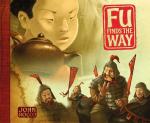 Fu is planting rice and is bored enough not to be doing it well, in neat rows. When he is rebuked, he throws a rice plant out of the paddy into the path of the warrior, Chang. The insulted warrior challenges him to a duel. Fu finds the sword Master and asks for help in getting ready. Through the night, all the Master does is teach him how to make and pour tea – with Purpose, Flow, and Patience. When Fu faces Chang in the morning he faces him with a teapot and suggests a pot of tea. Chang’s followers laugh at the boy, but Chang says, “There’s always time for tea.”
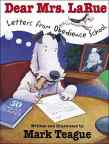 Ike is sent to Obedience School because he misbehaves. Read his heartrending letters to his master in this witty story. With each letter, see the luxury in which he is really living, with the black and white picture of what he is writing about. Ike eventually escapes, returns home, and rescues his owner.
 Henrietta, the chicken, loves to read and decides to write a book for herself. Having trouble getting it published, she self-publishes, but is sad after a bad review in the “Corn Book”. She is depressed until she discovers that children love her book.
 Diana Cruchley