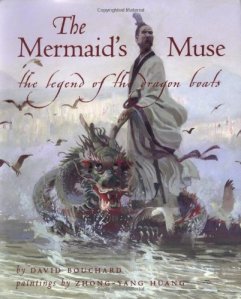
A poet named Qu Yuan, advisor to the King of Chu, is falsely banished to a far off island where the inhabitants really respect his wisdom. A dragon falls in love with him, and changes to a young woman, who asks him to come and live with her under the sea. The villagers assume, when they see him on the dragon, that he is going to be killed and they row out in their boats to save him, banging on the water to scare the dragon, throwing in rice cakes to distract the dragon, and attacking. The dragon refuses to fight back. The poet eventually changes himself into a dragon and says, “Do not believe everything your eyes will tell you.” After that, each year, the villagers celebrate the two dragons, and eventually come to celebrate with their own dragon boats.
David Bouchard, Raincoast Books, 1999, ISBN 9781551922485

Author: Dave Bouchard
Dave Bouchard is a former school administrator and teacher in BC. He has a school named after him in Ontario. He has received the Governor General’s medal and written many books. Three of his books are of Chinese folktales: The Mermaid’s Muse, The Dragon New Year, and The Great Race. Nine of his books reflect his Metis heritage which he discovered as an adult including I am Raven (click for teaching ideas).
Pourquoi Stories: How Things Came To Be
Pouquoi is French for “why”. This is a pourquoi story of how it came to be that there are dragon boat races and festivals around the world. Students could be asked to write their own imaginative, “how it came to be” story. One possibility is how the name of their school came to be, or the name of their town. Another is just an ordinary object such as an orange and how it came to be. Most pourquoi stories have a humorous element.
For example, I went to General Currie Elementary School in Richmond in grade one. We children believed that it was named after an American General (because that seemed more possible than a Canadian General) who had retired in Canada after the American Revolution. As an adult I discovered that he was the first Canadian commander of an all Canadian military division.
Art: Drawing the Dragon
There are many YouTube videos to teach students to draw important Chinese symbols, including the dragon. One I particularly like is How to Draw a Chinese Dragon by Paolo Morrone (below). Be prepared to stop the video at regular intervals so that students can catch up.
For more creative writing ideas, click The Mermaid’s Muse to download.




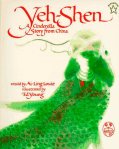 Yeh-Shen was the orphan daughter in her stepmother’s home, but the stepmother favoured her own daughter. Yeh-Shen’s friend, the fish, would come out of the water, rest on the shore, and she should feed it from her scarce resources. Her stepmother put on Yeh-Shen’s coat, lured out the fish, and killed it. As Yeh-Shen grieved, an old man appeared and told her to retrieve the bones, for they had power to grant wishes. Yen-Shen then wished on the bones for food. When the spring festival arrived (where young men and women could find partners), Yeh-Shen was not allowed to go. The bones of the fish made her an azure gown, a kingfisher feather cloak, and shoes of solid gold. When it looked like her stepmother would recognize her, she fled, leaving behind one gold slipper. In searching for his “bride”, the king noticed Yeh-Shen’s tiny feet, and when she tried on the slipper, her spring festival clothes reappeared on her. Ta da!
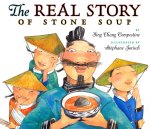 The fisherman in this story is fooled by his three nephews. They persuade him that they will make stone soup, then distract him at each point, in order to add real ingredients to the soup. He is
 Cinder Edna is the liberated neighbour of Cinderella. Cinderella needs a fairy godmother to get her to the ball; Cinder Edna earns money mowing lawns and cleaning parrot cages. She earns enough for the dress, wears comfortable loafers to the ball, and takes the bus. She gets the best prince too—the brother of the one Cinderella marries.
 In this twist on Aesop, the fox progressively involves a series of animals in an elaborate plan to help him get the grapes. He refuses to listen to their advice, and when his plan fails, he leaves saying the grapes are probably not ripe. After he leaves, the other animals get the grapes.
 Our fox makes somewhat of a “Rube Goldberg” plan, each part of which is more elaborate than next, and requiring ever more complicated diagrams. The original model of a plan that is too elaborate is named after Rube Goldberg. The illustration is of a machine to brush your teeth. Ask students to create a “Rube Goldberg” plan to do something simple like wash a car, or sharpen a pencil.
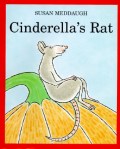 Cinderella’s Rat is captured in a cage, but is “rescued” by the fairy godmother and becomes the coachman for Cinderella’s trip to the ball. During the ball the coachmen wait, eating in the kitchen. Suddenly, his rat sister appears, looking for him, and to prevent the other coachman from killing him, over hero says she has been enchanted. They take her to a wizard to have her changed back to a girl. The wizard makes several errors and finally creates a girl with the voice of a dog. The happy ending is that the rat’s sister is great at scaring cats away. (More complicated to describe than to read.)
 Diana Cruchley