 This is the story of Mark Twain’s life in picture book form, with accompanying anecdotes from Susy who is writing this memoir so we can meet the “real” Mark Twain. Susy, Mark Twain’s favourite daughter, did keep a memoir of observations of her dad for a short period of time, and excerpts from it are included as little fold out pages. She talks about their home, his writing process and the role her mom plays, his leisure activities, and much more.
Barbara Kerley, Scholastic, ©2010, ISBN 978-0-545-12508-6
Spelling Mistakes
Mark Twain says his daughter’s spelling was frequently desperate.” Give students her spellings and ask them to spell them correctly—time them if you want to add some pressure. They need to add 5 seconds to their time for every word they still misspell.
Her incorrect words are: discribed incorectly, mustache, exept, extrordinary, sute, doute, Misouri, in good trimm, varius, chreatures (for creatures), expergate, donky, prosession.
This is a good time to mention that the first English dictionary was written in 9 years by one man, Samuel Johnson, and published in 1755. By contrast, the first French dictionary was written by an entire French Academy and published in 1694. It took 69 years to write. The first American dictionary was Noah Webster’s in 1806. After this spelling began to “solidify” into “correct” and “incorrect” spelling. Susy was writing in 1885.
A Book “In the Style Of”
This book has a particular style. For the most part it is a kind of story of Susy’s foray into biography. However, glued into place in the book are miniature foldout excerpts from Susy’s actual words. This is an excellent model to imitate.
In Social Studies it could take the form of a report on an explorer (for example) with inserted pages from his “diary” commenting on the events described on that page. In Science, it could be a report on a whale’s life cycle, with examples interspersed from the whale’s diary. In art, a research report on a particular artist could be written, with short imaginary diary inserts on occasion. Be sure that students realize the diary entries need only be 2-3 sentences long.
For 11 creative writing ideas, click The Extraordinary Mark Twain to download.
 James advises his younger brother on the 10 things you must not do if you ride the school bus. They range from not sitting at the front, not sitting at the back, not making eye contact with the bully, to not touching the bully’s stuff, not sitting with a girl, and finally to not talking to the bus driver. During the course of the day, his brother inadvertently breaks all 10. But he discovers that things work out and makes a rule 11—you don’t have to pay attention to the rules.
 Ed Young is well known for his picture books. The House Baba Built is more in the nature of a memoir of his childhood in the house his father built in Shanghai in which the family lived during World War II. We learn about the war, school, family activities in the house, taking in refugees including a Jewish family, food shortages, being unable to fill the pool…all through his eyes as a child. You can take just a part of this book for a rich study of many different topics.
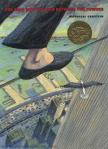 Philipe Petit was always challenged to walk the tightrope in as many difficult places as possible. As the twin towers were going up in New York in 2001 he determined that he would have to walk before it was finished and occupied. He organized friends, snuck in the ropes and rigging he would need with friends, suspended the rope and then he walked out into the wind. He walked, danced, ran, knelt, and even lay down on the rope. When arrested he was sentenced to perform for students in Central Park. The book ends poignantly with the shadows of the towers after the attack on September 11, 2001.
 Bridget’s loves to draw and is inspired by her beret. Unfortunately one day the beret blows away, and Bridget resorts to many other types of hats. None of them is inspiring. She is suffering from “painters block” until one day her friends who are opening a lemonade stand need a sign.. Bridget makes a series of signs (in the style of Whistler’s Mother, Van Gogh’s Starry Night, Andy Warhol’s Tomato Soup etc.). Her signs are viewed as an outdoor exhibit as passers by purchase lemonade at the “refreshment stand.” Of course, it ends with Bridget re-inspired to paint. This book also includes 2 pages of How to Start Your Art.
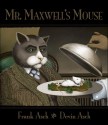 At the Paw and Claw restaurant it is lunch and Mr. Maxwell wants to celebrate his promotion with something special. He orders the headwaiter, Clyde to bring him a live mouse instead. When Clyde asks “Would you like us to kill it for you?” Mr. Maxwell replies, “That won’t be necessary.”
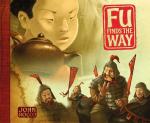 Fu is planting rice and is bored enough not to be doing it well, in neat rows. When he is rebuked, he throws a rice plant out of the paddy into the path of the warrior, Chang. The insulted warrior challenges him to a duel. Fu finds the sword Master and asks for help in getting ready. Through the night, all the Master does is teach him how to make and pour tea – with Purpose, Flow, and Patience. When Fu faces Chang in the morning he faces him with a teapot and suggests a pot of tea. Chang’s followers laugh at the boy, but Chang says, “There’s always time for tea.”
 Henrietta loves to read and has hardly any time to lay eggs. The farmer says he is sending all the rest of the hens on a vacation as a reward for their hard work. As they leave, Henrietta reads the words on their truck which say, “ Souper Soup Company” and realizes her friends are headed for the soup. Along the road to rescue them she hitchhikes pigs and cows. At the factory she reads the signs in the hallways to find the chickens, reads the code to find the address, and, after the rescue, finally discovers in a magazine a vegetarian farm where they can live.
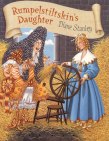 This fractured fairy tale begins after “Meredith” marries Rumpelstiltskin instead of the king and they have a daughter, Hope. Occasionally Rumpelstiltskin spins some gold and Hope takes it to the village. On hearing of it, the king captures her and demands she spin gold. She says she is not sure, but believes her grandfather did it with wheat. So it is planted across the kingdom. The peasants are happy, but the king still wants gold. Next, they try gold wool—again, the peasants are happy, but the king wants gold. Eventually, Hope becomes Prime Minister and, whenever the king becomes anxious, she takes him on a goodwill tour of his now happy kingdom.
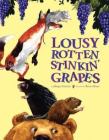 A wonderful retelling of the Aesop fable where the fox makes frequent attempts to get at the grapes until he finally says that they are probably sour anyway. Hence the expression “sour grapes”.
 Diana Cruchley