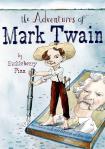
 Huckleberry Finn tells, in his own voice, of the life of his author Mark Twain, a.k.a Samuel Clemens.
Robert Burleigh and Barry Blitt, Atheneum Books, ©2011, 978-0-689-83041-9
A Story with Modern Expression
Huck Finn was written in the language of a back country boy in the 1800’s USA. Ask students to write any story in which they use common 21st century expressions to show how people “really talk”. First brainstorm the possible expressions students could consider: OMG, BFF, having a rush, goofing off, being gross, or lame, or awesome, or sweet, or cool. Something could rock, or suck. Things happen 24/7. There are zits. Things rock or rule.
Then ask students to write a very brief story in that “voice” as in the opening of Huck Finn. Something less that 200 words is fine. The objective is try out the “voice” of the 21st century.
Bad Luck Superstitions
Huck Finn said that Mark Twain’s luck turned bad like after “killing a spider”. Ask students to brainstorm bad luck superstitions they have heard of. They should be able to come up with:
- Step on a crack, break your mother’s back
- Break a mirror – 7 years bad luck
- Walk under a ladder
- Cross the path of a black cat
- A shiver means a goose walked over your grave
- Open an umbrella inside brings bad luck
- If you spill salt, toss it over your left shoulder or you’ll have bad luck
Students might enjoy writing a story about a character who frequently but inadvertently breaks bad luck superstitions and what happens to him or her, if anything.
For 10 creative writing ideas, click The Adventures of Mark Twain to download.
 Ralph Raccoon is too polite and too nice. His parents have to send him to Bandit School to learn to be a proper bad raccoon. How does Ralph use his “niceness” to succeed?
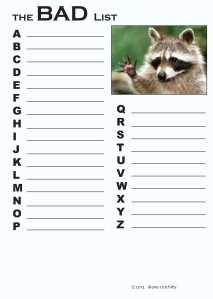 The Being Bad Alphabet
 In the country, in modern Japan, a little old couple lives quietly. The man says he misses his “rounds” (we don’t know what they are) and his wife makes him some candies so he can go into town on his bicycle and repeat what he used to do. He bicycles through busy streets to where the park used to be and sets up a little theatre. He recalls to himself what it was like to entertain crowds of children with his Japanese tales until television came. Coming out of his reminiscence he sees a crowd has gathered to hear these traditional tales and he gives out the candy his wife made.
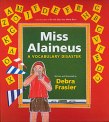 Sage is home sick, but she is trying to continue with her vocabulary homework. It goes awry when she mistakes miscellaneous for Miss Alaineus. Her mother is holding a box with spaghetti hair on it when she mentions she needs “miscellaneous things” from which Sage concludes she is the woman on the box. When she defines it that way, the whole class laughs. Sage is devastated until she ends as Miss Alaineus, Queen of All Miscellaneous Things at the Vocabulary Parade. This book is full of charming puns and built in word definitions.
 Diana Cruchley