 In this picture book, based on a Leo Tolstoy short story, our hero Nikolai seeks the answer to his three questions from a series of animals, ending with the wise turtle of the mountain. It is his response to a stranger’s cry for help that leads him to the answer. It’s a simple book based on three questions: What is the right time? Who is the most important one? What is the most important thing to do?
John J. Muth, Scholastic, ©2002, 978-0-439-19996-4
Fables
A fable has specific characteristics:
- There are animals in the story.
- The animals talk.
- The animals represent human qualities.
- A fable is very short.
- There is an explicit statement of the moral of the story.
By this definition, which of the qualities of a fable does this story have or not have?
Internet Version of the Book
I looked at several YouTube versions of this book, and think this is the best. If you want to read it yourself, simply turn off the sound, and read aloud as the story proceeds.
Philosophy for Kids
The Teaching Children Philosophy website has a collection of some interesting activities for students based around picture books (click book modules). Some discussions that might be useful are:
- What is it to be a hero? to be heroic?
- Give students a small collection of 3 songs. What makes a beautiful song? An ugly song? What makes something beautiful or ugly?
(This can be applied to images as well.)
For 10 creative writing ideas, click The Three Questions to download.

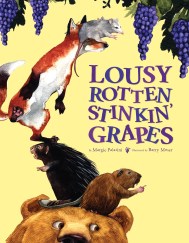 In this twist on Aesop, the fox progressively involves a series of animals in an elaborate plan to help him get the grapes. He refuses to listen to their advice, and when his plan fails, he leaves saying the grapes are probably not ripe. After he leaves, the other animals get the grapes.
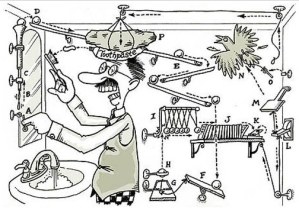 Our fox makes somewhat of a “Rube Goldberg” plan, each part of which is more elaborate than next, and requiring ever more complicated diagrams. The original model of a plan that is too elaborate is named after Rube Goldberg. The illustration is of a machine to brush your teeth. Ask students to create a “Rube Goldberg” plan to do something simple like wash a car, or sharpen a pencil.
 A classic Chinese folktale, of a man who owned a horse and at each turn of fate believed that things were neither as good, nor as bad, as they might seem.
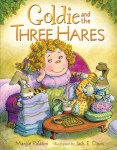 The Hare family is having dinner when Goldilocks, fleeing from the three bears, falls down the hole. Having hurt her foot, she remains as a guest, but is a terrible one. How can the Hare family get rid of her?
 A wonderful retelling of the Aesop fable where the fox makes frequent attempts to get at the grapes until he finally says that they are probably sour anyway. Hence the expression “sour grapes”.
 Diana Cruchley