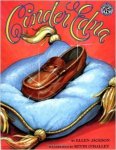
 Cinder Edna is the liberated neighbour of Cinderella. Cinderella needs a fairy godmother to get her to the ball; Cinder Edna earns money mowing lawns and cleaning parrot cages. She earns enough for the dress, wears comfortable loafers to the ball, and takes the bus. She gets the best prince too—the brother of the one Cinderella marries.
Ellen Jackson, Mulberry Books, 1998, ISBN 0688162959
Here It Is, and Again, and Again.
A turning point in the story is going to be that Cinder Edna knows 16 ways to make tuna casserole. The fact is planted in the story when we first meet her and it is listed as one of her skills. It is mentioned again when she meets Rupert and discovers he likes tuna casserole too. Finally, Rupert uses the 16 types of tuna casserole to determine which is the real Cinder Edna.
This is a really great skill to teach students when writing a story. When you have decided on the solution to your problem, you can plant it into the story three times—the first two quite unobtrusively. It makes the whole story seem to come together perfectly.
What Happened Next Stories
In addition to being really entertaining, the “What Happened Next” story is a natural development of the predicting skill of reading. It is also easy to write because students do not have to create a character, a setting, a problem, etc. They can limit themselves to a problem or two for their character.
There are many existing “What Happened Next” stories, but you will not want to have the students read them before they write their own. However, studying them afterward can show students that many adults do what they have just done and make a good living doing it.
First, brainstorm a list of fairy tales where “What Happened Next?” Here are some possibilities: Goldilocks and the Three Bears, The Three Little Pigs , Three Billy Goats Gruff, Little Red Riding Hood, Snow White and the Seven Dwarfs, Rapunzel, Sleeping Beauty, and The Frog Prince.
For 5 creative writing ideas, click Cinder Edna to download.
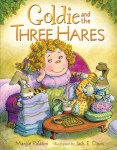 The Hare family is having dinner when Goldilocks, fleeing from the three bears, falls down the hole. Having hurt her foot, she remains as a guest, but is a terrible one. How can the Hare family get rid of her?
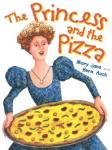 The king has given up his kingdom and his daughter decides to try to marry Prince Drupert so she enters the competition for his hand. During the food portion of the competition she accidentally invents pizza and discovers that she would rather sell pizza than marry the prince.
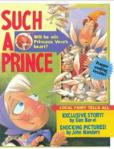 Marvin, is small, skinny, and in competition for the princess with several rude suitors. With the assistance of an an unusual fairy he succeeds in presenting the princess with the three perfect peaches she needs. Unfortunately, rather than giving him his daughter, the kind presents him with challenges including fattening 100 rabbits without losing any of them. Of course he succeeds, with a little magic. An adaptation of a French fairy tale.
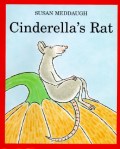 Cinderella’s Rat is captured in a cage, but is “rescued” by the fairy godmother and becomes the coachman for Cinderella’s trip to the ball. During the ball the coachmen wait, eating in the kitchen. Suddenly, his rat sister appears, looking for him, and to prevent the other coachman from killing him, over hero says she has been enchanted. They take her to a wizard to have her changed back to a girl. The wizard makes several errors and finally creates a girl with the voice of a dog. The happy ending is that the rat’s sister is great at scaring cats away. (More complicated to describe than to read.)
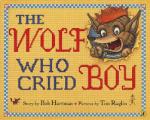 Little Wolf never likes what is made for dinner: Lamburgers, Sloppy Does, Chocolate Moose—nothing pleases him. All he can think about is “boy”—boy chops, baked boy-tatoes and boys -n-berry pie. On the way home to three pig salad, Little Wolf has the idea of pretending to see a boy. After this trick results in him getting junk food for several nights, his father overhears him bragging to a friend. They refuse to listen to him…even though he has seen an entire troop of boy scouts in the woods, and one even enters the cave. Lesson learned, and the boys, at least, live happily ever after.
 Our illustrator is racing through the book trying to tell the story of a pie-loving king who has imprisoned his stepdaughter. He will only release her when a suitor kills the dragon. We, “the readers”, are reading too fast for the illustrator to keep up. This results in emergency art substations that detour our plot.
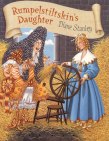 This fractured fairy tale begins after “Meredith” marries Rumpelstiltskin instead of the king and they have a daughter, Hope. Occasionally Rumpelstiltskin spins some gold and Hope takes it to the village. On hearing of it, the king captures her and demands she spin gold. She says she is not sure, but believes her grandfather did it with wheat. So it is planted across the kingdom. The peasants are happy, but the king still wants gold. Next, they try gold wool—again, the peasants are happy, but the king wants gold. Eventually, Hope becomes Prime Minister and, whenever the king becomes anxious, she takes him on a goodwill tour of his now happy kingdom.
 The pea under the mattress writes a memoir of his attempt to help the prince find a “real princess.” Eventually the gardener’s girl who raised the pea lies on the twenty mattresses and he whispers, “You are very uncomfortable,” in her ear all night. She repeats this to the queen in the morning and marries the prince. The pea lives on in the royal museum.
 The story of Hansel and Gretel as told by Gretel, in her own voice and with her point of view. A very clever pop-up story—and a potential model for student pieces.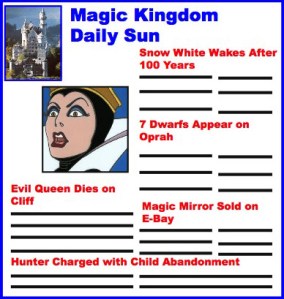
 Diana Cruchley