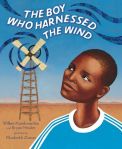
 The true story of a boy living in Malawi who created a windmill to generate electricity and pump water for his village.
William Kamkwamba, Penguin, ©2012, 978-0-8037-3511-8
Science of Corn
As a science study, you could bring in jeweller’s loupes and enough corn so that each pair of students can have a slice. Use the loupes to have students ask themselves, “What does this look like? What does it remind me of?” They should think of 5-10. Some examples are:
- tiny pats of butter
- little yellow pillows
- coated pills
- colourful pool toys
- little balloons
The science question is, “If it looks like a tiny pat of butter, is there any way it could act like a tiny pat of butter?” Of course, corn oil, is very high calorie and often used as a replacement for butter, so that isn’t too hard.
What about “If it looks like a little yellow pillow, is there any way it could be acting like a little yellow pillow?”
A good Inquiry series of questions can come out of these, and often a little experiment can be constructed to test whether it is indeed acting like what it looks like. For example, could we extract a kernel carefully and see if it floats, like a pool toy?
Remind students that 95% of nature is function over form. That is, it doesn’t look beautiful just to look beautiful; there is a reason for it.
An Inquiry into Crops of the Americas
Historically, corn was one of the North American crops exported around the world, so it is interesting that it is the major crop of Malawai. Students may be interested in investigating what other foods originated in the Americas, including chocolate, tobacco, potatoes, vanilla, tomatoes, peanuts, avocado, chili peppers, papaya, pineapple, maple syrup, sunflower, wild rice, turkey, cranberry, sweet potato, quinoa, brazil nuts, cashews.
Art
The Internet has lessons for how to draw nearly anything—in this case, an ear of corn. You could start students with a cartoon corn:
Followed by a more sophisticated drawing:
For 9 creative writing ideas, click The Boy Who Harnessed the Wind to download.
 Wabi Sabi, the cat, goes on a journey to find the meaning of her name. She asks a cat friend, a dog, a bird, and finally a monkey. Each says, “That’s hard to explain”—the catch phrase of the book. Slowly she discovers that it is a kind of humble beauty, you will be exploring with student.
 This book is not new, but has been recently re-issued, so I am including it because it is great for writing ideas. The Quiltmaker makes quilts only for the poor. When the king covets one she refuses, but will make one square for each gift he gives away. After several threats, he gives in, and finds that giving to others is where he find happiness.
 Latitude and Longitude are just imaginary lines on the surface of the earth, but are critical to navigation. Latitude (north and south) was known, but it wasn’t until John Harrison (a clockmaker) tackled it in the 1700’s in order to win a prize, that the problem was solved.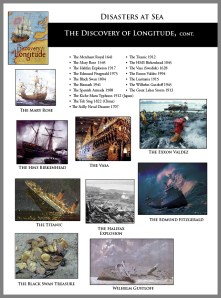
 Diana Cruchley