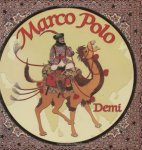
Marco Polo

The story of Marco Polo and his trip from Venice to Beijing starting in 1271 and his return 24 years later. The illustrations are in an eastern 13th century style, with gilding and gorgeous elaborate borders all using Chinese inks. Be selective in your choices of what you read – it is a long picture book.

Demi, Marshall Cavendish Chidren, ©2008, 978-0-7614-5433-5

Here is a three-minute summary of Marco Polo’s travels …without the amazing things that he saw and reported. It could be a quick introduction before you start your selected readings.

The Life Lessons of Marco Polo

Try giving the students a set of potential life lessons we could learn from Marco Polo before you read excerpts from the book. Ask them to listen and select four potential lessons. Tell them they can also draw lessons of their own from your readings. For each of them, they are to write one paragraph explaining how Marco Polo exemplifies that lesson. Discuss their opinions in small groups and as the class.

  1. Go outside your comfort zone.
  2. Always record your travels.
  3. Taste many different types of food.
  4. Stick to your guns.
  5. Be prepared to take risks.
  6. Build a network of connections and friends.
  7. Work hard for your money.
  8. Learn other languages.
  9. Be charming.

Why You Wouldn’t Want to Take A Trip with Marco Polo

An opposite point of view could be taken of Marco Polo’s travels…and that is, all of the privations and dangers he encountered. Ask students to listen as you read, and make a list of things that were difficult on his journey…then to write a letter, or an essay, or a rant about “Why I Wouldn’t Want to Take a Trip with Marco Polo.”

Zentangles

While Demi’s used patterns and designs common in the Middle East in the 1200’s, those are difficult for students to imitate. On the other hand, elaboration of design within an outline can be easily achieved using zentangles. There are many websites and YouTube videos dedicated to zentangle, a popular contemporary “doodle” students can use to create a frame or illustration for a piece of their own writing. Start with a simple outline drawing, and then pattern the inside. This particular YouTube not only demonstrates fitting designs into an outline, it also provides many different patterns students can imitate. Have a set of patterns available on a single sheet of paper for each student as well.

For 10 creative writing ideas, click Marco Polo to download.
Alfred Nobel: The Man Behind the Peace Prize

Alfred NobelAlfred Nobel invented dynamite and became very wealthy.  Saddened by its us in war he left his entire fortune to a yearly prize for those “who have rendered the greatest services to mankind.”

Kathy-Jo Wargin, Sleeping Bear Press, ©2009, ISBN 978-1-58536-281-3

Famous Winners of the Nobel Prize

Divide the class into 4 giving you approximately 8 groups. Further divide them until there are 8 groups of 4. Give each group 4 names from the Prize Winners Page to search at NobelPrize.org. As they click each name, they will find a picture of the winner and the biography will give them a description of what the person did that made them a worthy winner of the prize.

prize winners pageEach chooses one of their 4 names and writes from 50-100 words describing their winner. These can be turned into oral presentations if you wish. Have students with the same winner work together.

Nobel Prize Games

NobelPrize.org has more than 10 great games you can play to learn more about the Nobel Prize winners, about science and medicine, as well as a nice “doves game” which would fit in well with the theme of this book. Games include:  Laser Challenge, blood typing, Pavlov’s dog, double helix, electrocardiogram, peace doves, split brain, and the immune system.  They are really fun to play, and demanding. Click here to visit the Nobel Prize Games.

Origami:  The Crane

Because the crane is a symbol of peace in Japan, this can also be a time to introduce the book Sadako and the Thousand Cranes by Eleanor Coerr.  This is the story of the little survivor of Hiroshima who succumbs to leukemia—“the atom bomb disease”—and makes a thousand origami cranes in order to wish for peace.

There are several YouTube sites with more information on Sadako—as well as this being a good time to teach students how to make the origami crane.

For 8 creative writing ideas, click Alfred Nobel: The Man Behind the Peace Prize to download.

From the Good Mountain

FromtheGoodMountainHow Gutenberg Changed the World. Illustrated like a medieval manuscript, the book shows how all the parts of the process came together to create the first printing press.
James Rumford, Roaring Book Press, ©2012, ISBN 978-59643-542-1

Writing From the Parts

The structure of this book is to describe something without saying what it is, and then to ask a question.

  • What was it?

Then it describes how to make the thing, and asks another question:

  • What was this thing made of rags and bones?

Then it answers it, and says it was ready.

  • It was paper, and it was ready.

Slowly, the story builds as the next thing needed is leather, then gold, then ink, then printing types, then the printing presses, then the person (Johannes Gutenberg) until finally the book is made.

It’s a gorgeous, rhythmical pattern that students could imitate with something easier, such as making fudge. To make fudge you need:

  • sugar
  • butter
  • brown sugar
  • icing sugar
  • a stove
  • a glass tray
  • a knife
  • a refrigerator

The recipe online for Cora’s fudge is the easiest one I know, because it doesn’t require any temperature gauge. Students don’t make the fudge—you do so that you can give out a sample.

“In the year 2012, in the city of New Westminster, there appeared a mysterious thing. It was made of sugar cane, cows milk, brown sugar, icing sugar, a stove, a fridge, a glass tray, and a knife. What was it?”…and so on.

It would be fun…and they could see that any time they needed to explain something where many other things had to come together first in order for the item to be successful…this pattern would be very impressive.

The recipe for Cora’s fudge is at here. (One tip: when it is partially chilled, make cut lines in the fudge, so that it comes out more easily in the end. If you forget, this will still work.)

Paper chase Vocabulary Game

Here’s a chance to develop the vocabulary of paper. Find samples of all of these kinds of paper and create 8 different packages with labels. Allow students to feel and look at, and study the names of the papers. Then remove these study material.

Next given them an envelope with sample papers and separate labels and ask them to match the word to the sample. Add a timing factor to make it more fun.

  1. bond paper
  2. cellophane
  3. parchment paper
  4. cardboard
  5. blotting paper
  6. carbon paper
  7. cardstock
  8. butcher paper
  9. newsprint
  10. crêpe paper
  11. glassine paper
  12. origami paper
  13. wax paper
  14. tissue paper
  15. wrapping paper
  16. manila tag
  17. toilet paper


For 10 creative writing ideas, click From the Good Mountain to download.

Titanicat

Titanicat CoverJim is a cabin boy on the Titanic assigned to watch over a cat and her kittens. He sees the cat taking her kittens off the ship before it sails. As the “All ashore” is called there is one last kitten, so Jim takes it off and misses the ship. Based on a true story.

Marty Crisp, Scholastic, ©2008, ISBN 978-0-545-2880-2

Superstitions

Our cabin boy is saved from the Titanic because of the superstition that a cat leaving a ship is a sign of disaster. Show students the pictures on the Titanicat Superstitions PDF and have them describe what the luck is that the image is conveying (good or bad).

Cat Breeds

The ship’s cat is a tortoiseshell cat. This might be a good time to introduce students to the names and vocabulary of cat breeds, some of which are:

  • Ragdoll
  • Maine or coon cat
  • Bengal
  • Siamese
  • Manx
  • Persian
  • Abyssinian
  • Angora
  • Russian blue

For 10 creative writing ideas, click Titanicat to download.

The Librarian Who Measured the Earth

librarian-who-measured-cover jpgThe biography of the ancient Greek mathematician and librarian who measured the circumference of the earth, with an error of only 200 miles, at a time when people didn’t even know for sure the earth was round, using math alone.
Kathy Lasky, Little Brown and co., ©2004, ISBN 0-316-51526-4

Ancient Libraries

The Library at Alexandria was the greatest library on earth for over 1000 years. There were over 700,000 rolls of papyrus in their collection of “books.” You couldn’t take a book out, so a librarian would help you find the scroll you had in mind.

For Rapid Research (click for PDF) it would be great for students to find out everything they can about the following libraries or book collections and write their own “book” of 200-400 words:

  1. The Library at Alexandria
  2. The House of Wisdom
  3. The Library at Ephesus
  4. The Library at Constantinople
  5. The Burning of the Mayan Books
  6. Hitler’s Book Burning
  7. The Cordoba Library – Library of Al-Hakam III


Look Like a Math Genius – The 11 X Table

Teach students how to multiply a two-digit number, in their head, faster than a calculator.

43 x 11 = ???

Answer:

  • The first number is 4
  • The last number is 3
  • The middle is their sum = 7
  • The answer is 473

Tell them to say it slowly, to impress their friends.

For 8 creative writing ideas, click The Librarian who Measured the Earth to download.

The Boy Who Drew Birds

boywhodrewbirdsJames Audubon was French, and was sent to America to learn business, and also to avoid French military service in Napoleon’s army. While there, he became passionate about the observation and detailed paintings of birds. This is his story with particular emphasis on his “test” of migration.

Jacqueline Davies, Houghton Mifflin, ©2004, ISBN 0-618-24343-7

Audubon Art

First, students need to watch a YouTube on drawing birds. The one I liked best, is a little “cartoon-like” but it is fast, and clear and could be adapted to more “realistic drawings.

Next, provide a set of Audubon style drawings for students to “observe”. Ask them to draw just one of the birds. They should sketch in pencil, and then go over it when adding details, using ink. Finally they would erase the original pencil, and finish with coloured crayons or felts.

Tell them not to worry because when the original inspiration is taken away, their drawing will look really good. (A lot of students think that “real drawing” needs to be done from your head. No. All great artists had models, observed from nature; or now they start with a photo.)

If students draw on a piece of paper around 3 X 5 inches, it can be turned into a very nice card for Mother or Father’s Day.

Famous Naturalists Vimeo

Click The Great Naturalists to watch a video for the University of Idaho about some of the most famous naturalists.

Famous Naturalists – Rapid Research

List of Famous NaturalistsNaturalists study nature the way it is rather than the way theories say it is. As a result, going back to Aristotle, there has been steady progress in science because of the work of naturalists. The attached pages describe 17 naturalists and their contributions to the study of the real world. This can be a great Rapid Research project to build general knowledge about history (useful as well in building vocabulary), speaking and writing skills, and, of course, research skills.

Working in pairs, students must find 20 facts about their naturalists and present a list of 20 complete sentences describing what they have found. There are then several options:

  • Students each write their own essay describing what they have found out, which is marked, then mounted on cardstock and illustrated from the Internet for a very effective classroom display of student work.
  • Finished essays can be submitted with a literal question and an answer from the book. Once the finished essay is mounted, the question is added and the answer form part of a key on your desk. The cardstock items are numbered in 72 point numbers, and then students circulate to find 5 answers from the pages. They may go in pairs, but only one pair may be at a station at a time in this Scavenger Hunt.
  • The illustrations for the naturalists can be quickly placed by you into a Keynote or PowerPoint presentation and students, again in pairs, have each 1 minute (2 minutes in total) to present their information. This is the one most likely to increase general knowledge in students.

For 7 creative writing ideas, click The Boy Who Drew Birds to download.

The Discovery of Longitude

Longitude coverLatitude and Longitude are just imaginary lines on the surface of the earth, but are critical to navigation. Latitude (north and south) was known, but it wasn’t until John Harrison (a clockmaker) tackled it in the 1700’s in order to win a prize, that the problem was solved.
Joan Marie Galat, Pelican ©2012, 978-1-4556-1637-4

Great Shipwrecks

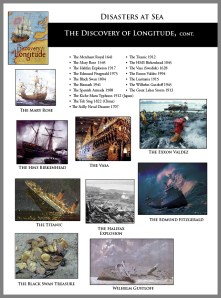
In the 21st century, with GPS and vast improvements in diving equipment, many wrecks are now being found, and even being raised from the sea.

Students could conduct a Rapid Research topic where groups look into 17 famous shipwrecks:

  • The Mary Rose, 1545
  • The Spanish Armada, 1588
  • The Vasa (Swedish), 1628
  • The Merchant Royal, 1641
  • The Scilly Naval Disaster, 1707
  • The Black Swan, 1804
  • The Tek Sing, 1822 (China)
  • The HMS Birkenhead, 1845
  • The Titanic, 1912
  • The Kiche Maru Typhoon, 1912 (Japan)
  • The Great Lakes Storm, 1913
  • The Lusitania, 1915
  • The Halifax Explosion, 1917
  • The Bismarck, 1941
  • The Wilhelm Gustloff, 1945
  • The Edmund Fitzgerald, 1975
  • The Exxon Valdez, 1994

discoverwrecks

Using the Internet, in a limited period of time, students find out:

1. What was this wreck, where was it located, why was it important? When did it happen?

2. What was the impact of this wreck on future navigation if any?

They create a PowerPoint, an essay, a speech, etc. as a group – pooling their research and writing in a “voice” that is aimed at their own grade level.

Careful Listening

Students can be asked to listen very carefully and make note of the PROBLEMS that some of the early solutions to navigation had. Note-taking is one of the critical skills for achievement according to Marzano.

For 7 creative writing ideas, click The Discovery of Longitude to download.

Blockhead – The Life of Fibonacci

BlockheadFibonacci was part of the revolutionary change from Roman numerals to Arabic numerals in the 12th century. His most important contribution to math is the Fibonacci sequence, which this book explains.

Joseph D’Agnesi, Henry Holt, 2010, ISBN 978-0-8050-6305-9

Fibonacci Numbers

If you add any two consecutive numbers in the pattern you get the next number:

  • 1 pair plus 1 pair = 2 pairs
  • 1 pair plus 2 pairs = 3 pairs
  • 2 pairs plus 3 pairs = 5 pairs
  • 3 pairs plus 5 pairs = 8 pairs

The first numbers are 1,2,3,5,8,13,21,55,89,144,233,377.

Pages 26 and 27 explain the Fibonacci numbers…demonstrate to 8 and ask them to continue until they get to 233.

blockheadphotoAstonishingly, nature uses these numbers all the time…in flower petals, seeds inside, starfish, 3 leaf clovers, 8 sections in a lemon, etc. Even humans have 1 head, 2 eyes, 5 fingers, etc.
Roman Numerals

The book mentions that, in Egypt, Fibonacci encountered Arabic Numerals and thought how much simpler they were than his Roman numerals – making it a good time to introduce them. (Actually, the numbers are from India, but the west encountered them in the Arab countries and so called them Arabic numerals.) Lots of sites have activity sheets, but a good site for an explanation is Adrian Bruce’s Maths Stuff. Roman numerals, it reminds us, may be found on watches, old buildings, page numbers in a preface, as subsections in a list on Microsoft Word, titles of kings and queens, periods of Egyptian history, and at the end of Hollywood movies, comics, and games to show the year it was made.

For 8 creative writing ideas, click Blockhead to download.

Wonder Horse

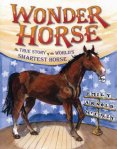
Wonder HorseSubtitled The True Story of the World’s Smartest Horse, this is the story of how Bill Key, former slave, found and trained his horse Jim Key. Unlike other trainers of the time, he used only kindness to teach Jim to recognize the alphabet and colours. They travelled America doing shows, where Bill took the opportunity to teach animal owners the importance of humane treatment. Bill and his horse had a huge influence on the movement leading to the RSPCA.

Emily Arnold McCully, Henry Holt, ©2010, ISBN 978-0-8050-8793-2

Famous Animals – A Rapid Research Topic

Jim Key is the story of both an amazing horse and an amazing owner. Give students a list of famous animals and ask them to prepare a quick research report of about 4 paragraphs (with an illustration if possible from the internet) to make an 11 X 17 poster set of displays for the class.

Working in pairs, students could then make an oral presentation (or a PowerPoint presentation about their particular horses)..length 2 minutes to a maximum length of 5 minutes.

I have created a Pinterest page with 30 amazing animals (horses, dogs, cats) that students can use to start their research (or illustrate it). You can either visit my Pinterest page on my website to view the board (it’s the last one on the page) or visit my Pinterest boards directly (also, don’t forget to follow me on Pinterest!).

Vocabulary

The words students might find difficult are: colic, profile, console, antics, equine, and liniment. This might be a good time to explore vocabulary about horses as a theme. (See page 3 of the attachment.)

For 5 creative writing ideas, click Wonder Horse to download.

Tsunami

TsunamiIn Japan, the oldest and wealthiest man in the village lives on the hill in his rice farm. In the village below, villagers are getting ready for a festival. Suddenly he senses a problem, and when he sees the waters recede realizes a tsunami is coming. He cannot get down to the village to warn them in time so he needs to draw the villagers to him. As a desperate act, he sets his crop on fire. The villagers rush up the hill to help put out the fire, and they are all saved.

Kimiko Kajikawa, Philomel Books, ©2009, ISBN 978-0-399-25006-4

Tsunami

This is a good time to study the science of the tsunami. These giant waves form where tectonic plates collide, where there is a gigantic (frequently underwater) eruption of a volcano, or after a meteor impact. 86% of all tsunamis come from underwater volcanoes or seismic shifts. These displace huge quantities of water suddenly. The water rushes in to fill the vacuum (thus explaining why the “tide” seems to go out suddenly and unusually far) and then rushes back out again in the form of a huge wave.

There are many websites with great information including the video below.

The True Story

This book is based on a story in the 1897 publication by Lafadio Hearn called Gleanings in Buddha-Fields. The original wise wealthy man of the village was Hamguchi Goryo and there is a Japanese museum dedicated to him. (He was 35, not an old man, when it happened but the story is still wonderful. Making him older makes it possible for “experience” to tell him what to do.) Ask students to research the real person at locations such as The Fire of Rice Sheaves.

For 8 creative writing ideas, click Tsunami to download.