
Wallace Hartley is the man who played the violin as the Titanic sank. He was praised as the “bravest man in the world” because he was offered a space on a lifeboat, but instead stayed to calm the scared passengers by playing as the ship sank. The story is told by Jonathan Harker, a stowaway befriended by Hartley, to his grandson who doesn’t want to practice the piano.
Patricia Polacco, Simon and Schuster, ©2019, ISBN 978-1-4814-9461-8
Inquiry: Famous Disasters at Sea
It might make a good “rapid research” inquiry topic for students in pairs to find the basic when, where, why, how for the disasters. They need to also create ten interesting sentence facts about the disasters.
They could also pose questions themselves for all disasters: What are the most common causes of marine disasters? Were any changes to the “rules” of the sea made after the disaster? Why do we particularly remember these disasters? How many people died? How do we know these disasters occurred?
It helps if the students generate the questions themselves. At the end, create a chart with questions down one side and disasters across the top. With each question, have students chime in anything that found that would help to answer the question. This is genuine evidence-based research of the kind for which scholars get doctorates. Example of past famous disasters at sea are:

- The Mary Rose, 1545
- The Spanish Armada, 1588
- The Vasa (Swedish), 1628
- The Merchant Royal, 1641
- The Scilly Naval Disaster, 1707
- The Black Swan, 1804
- The Tek Sing, 1822 (China)
- The HMS Birkenhead, 1845
- The Titanic, 1912
- The Kiche Maru Typhoon, 1912 (Japan)
- The Great Lakes Storm, 1913
- The Lusitania, 1915
- The Halifax Explosion, 1917
- The Bismarck, 1941
- The Wilhelm Gustloff, 1945
- The Edmund Fitzgerald, 1975
- The Exxon Valdez, 1994
Other Picture Books About the Titanic
There seem to be innumerable books about the Titanic written with children in mind: pop-up books, colouring books, detective books, etc.
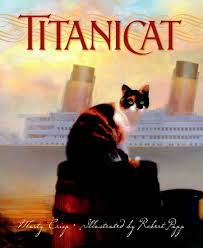
Titanicat (click for teaching ideas) is the story of a genuine survivor of Titanic who by a twist of fate did not get on the ship.
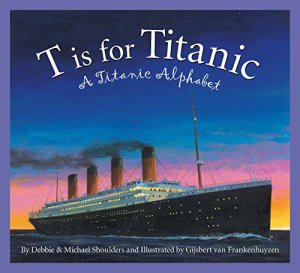
T is for Titanic is an ABC book for words from the Titanic. I have always had success with selecting a topic under study in Social Studies and having students working to create an ABC book of short paragraphs about that topic. If you have lots of time, students can work in pairs to create the book with each student doing 13 letters, but it can also be done where the class generates a list (or you do) of words that apply. Have students individually finds facts and write an interesting paragraph about the the word as applied to the topic such as the ABCs of Egypt, Haida, Japan, etc.
For more creative writing ideas, click on The Bravest Man in the World to download.


 Bruce, the bear, is gathering eggs for his dinner recipe, but unfortunately they hatch. The ducklings immediately imprint on Bruce and follow him everywhere. After trying to get them to leave he gives up and raises them, even trying to teach them to migrate. When that fails, they end by vacationing in Miami every year.
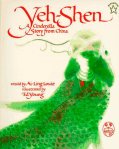 Yeh-Shen was the orphan daughter in her stepmother’s home, but the stepmother favoured her own daughter. Yeh-Shen’s friend, the fish, would come out of the water, rest on the shore, and she should feed it from her scarce resources. Her stepmother put on Yeh-Shen’s coat, lured out the fish, and killed it. As Yeh-Shen grieved, an old man appeared and told her to retrieve the bones, for they had power to grant wishes. Yen-Shen then wished on the bones for food. When the spring festival arrived (where young men and women could find partners), Yeh-Shen was not allowed to go. The bones of the fish made her an azure gown, a kingfisher feather cloak, and shoes of solid gold. When it looked like her stepmother would recognize her, she fled, leaving behind one gold slipper. In searching for his “bride”, the king noticed Yeh-Shen’s tiny feet, and when she tried on the slipper, her spring festival clothes reappeared on her. Ta da!
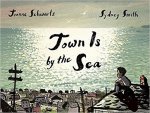 Written in the first person, a boy tells of his simple day. First he describes the setting by the sea with a house, a road, a grassy cliff, the sea, and the town and his father digging coal under the sea. Then getting up, going to the playground, having lunch, doing an errand in town, visiting his grandfather’s graveyard and and going home, listening to the radio, having dinner, An ordinary day, and at every stage he thinks of his father digging coal under the sea.
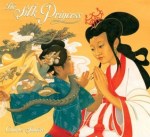 Hsi-Ling Chi is the daughter of the Emperor and is rarely noticed. The Emperor has been seeking for a cloth worthy of his nobility. One day, Hsi-Ling Chi notices a cocoon has fallen in her mother’s tea and is unraveling. They play a game to see how long it is and the little girl ties it around her waist. She goes out past the stone garden, past the spider, outside the palace, to the holy mountains where a dragon threatens her. Along the way she loses the thread, but meets a hermit who shows her how the silk can be woven, and offers to take her home. She falls asleep, wakens to no silk cloth but still with the silk thread tied around her waist—the whole thing was a dream. When she gets back her mother hears her story and thinks, “Hmm? Is this possible?” She summons the royal weavers and the rest is history.
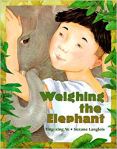 In the mountains of China was a small village living peacefully with their working elephants. They especially liked the baby elephant who would play with the children. The Emperor demanded the baby elephant but it refused to play with the Emperor’s children. The Emperor determined to put him death, but first posed an absurd riddle—whoever could weigh the elephant could win it. A little boy in the village solved the problem (by using displacement) and the baby elephant returned home.
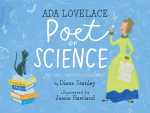 The story of how 200 years ago, the daughter of Lord and Lady Byron, Ada Lovelace, wrote the first program—before there was electricity to make it work. Working with Thomas Babbage on the Analytical Engine, she wrote step-by-step how Bernoulli numbers could be coded for the machine.
 Diana Cruchley