 Bridget’s loves to draw and is inspired by her beret. Unfortunately one day the beret blows away, and Bridget resorts to many other types of hats. None of them is inspiring. She is suffering from “painters block” until one day her friends who are opening a lemonade stand need a sign.. Bridget makes a series of signs (in the style of Whistler’s Mother, Van Gogh’s Starry Night, Andy Warhol’s Tomato Soup etc.). Her signs are viewed as an outdoor exhibit as passers by purchase lemonade at the “refreshment stand.” Of course, it ends with Bridget re-inspired to paint. This book also includes 2 pages of How to Start Your Art.
Tom Lichtenheld, Henry Holt, ©2010, 978-8-8050-8775-8
Artist Study Inspired By the Book
The following artists are mentioned in the back pages of the book or illustrated in the book itself: Monet, Cezanne, Georgia O’Keefe, Henri Matisse, Alfred Sisley, Guisseppe Arcimbolda, Mary Cassatt, Vincent Van Gogh, Georges Seurat, Rembrandt, Pablo Picasso, Andy Warhol, James Whistler.
Here’s a rapid research task for your students. Each pair of students would have 1 hour of computer time and an hour to write their product for presentation. For each artist they need to find a sample piece of art, 10 facts about the artist and 5 important facts about the piece of art (not including its title).
For general cultural literacy, and to meet one of the learning outcome for art, they would present their findings as a poster with the art piece pasted in place, or a PowerPoint oral presentation with illustrations.
Hats and Vocabulary
Bridget tries on a coonskin cap, a propeller beanie, a fez, a cowboy at, a fishing hat, a baseball cap, a gardening hat, and a pith helmet without success. To build vocabulary this is a good time to learn to name the many different kinds of hats there are.
A page of hat pictures is included with the pdf of teaching ideas. First students would study the hats with the key. Then, print on card stock a single sheet for every two students and ask them to cut them up to make sets. Students take turns timing each other to see who can name them the fastest, keeping in one pile the ones they get right, and in another the ones they get wrong.
For 7 creative writing ideas, click Bridget’s Beret to download.
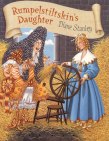 This fractured fairy tale begins after “Meredith” marries Rumpelstiltskin instead of the king and they have a daughter, Hope. Occasionally Rumpelstiltskin spins some gold and Hope takes it to the village. On hearing of it, the king captures her and demands she spin gold. She says she is not sure, but believes her grandfather did it with wheat. So it is planted across the kingdom. The peasants are happy, but the king still wants gold. Next, they try gold wool—again, the peasants are happy, but the king wants gold. Eventually, Hope becomes Prime Minister and, whenever the king becomes anxious, she takes him on a goodwill tour of his now happy kingdom.
 Ralph Raccoon is too polite and too nice. His parents have to send him to Bandit School to learn to be a proper bad raccoon. How does Ralph use his “niceness” to succeed?
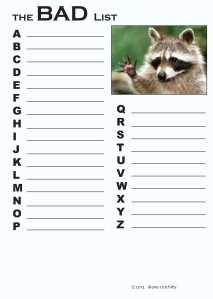 The Being Bad Alphabet
 The pea under the mattress writes a memoir of his attempt to help the prince find a “real princess.” Eventually the gardener’s girl who raised the pea lies on the twenty mattresses and he whispers, “You are very uncomfortable,” in her ear all night. She repeats this to the queen in the morning and marries the prince. The pea lives on in the royal museum.
 Diana Cruchley