
Wallace Hartley is the man who played the violin as the Titanic sank. He was praised as the “bravest man in the world” because he was offered a space on a lifeboat, but instead stayed to calm the scared passengers by playing as the ship sank. The story is told by Jonathan Harker, a stowaway befriended by Hartley, to his grandson who doesn’t want to practice the piano.
Patricia Polacco, Simon and Schuster, ©2019, ISBN 978-1-4814-9461-8
Inquiry: Famous Disasters at Sea
It might make a good “rapid research” inquiry topic for students in pairs to find the basic when, where, why, how for the disasters. They need to also create ten interesting sentence facts about the disasters.
They could also pose questions themselves for all disasters: What are the most common causes of marine disasters? Were any changes to the “rules” of the sea made after the disaster? Why do we particularly remember these disasters? How many people died? How do we know these disasters occurred?
It helps if the students generate the questions themselves. At the end, create a chart with questions down one side and disasters across the top. With each question, have students chime in anything that found that would help to answer the question. This is genuine evidence-based research of the kind for which scholars get doctorates. Example of past famous disasters at sea are:

- The Mary Rose, 1545
- The Spanish Armada, 1588
- The Vasa (Swedish), 1628
- The Merchant Royal, 1641
- The Scilly Naval Disaster, 1707
- The Black Swan, 1804
- The Tek Sing, 1822 (China)
- The HMS Birkenhead, 1845
- The Titanic, 1912
- The Kiche Maru Typhoon, 1912 (Japan)
- The Great Lakes Storm, 1913
- The Lusitania, 1915
- The Halifax Explosion, 1917
- The Bismarck, 1941
- The Wilhelm Gustloff, 1945
- The Edmund Fitzgerald, 1975
- The Exxon Valdez, 1994
Other Picture Books About the Titanic
There seem to be innumerable books about the Titanic written with children in mind: pop-up books, colouring books, detective books, etc.
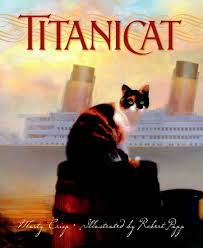
Titanicat (click for teaching ideas) is the story of a genuine survivor of Titanic who by a twist of fate did not get on the ship.
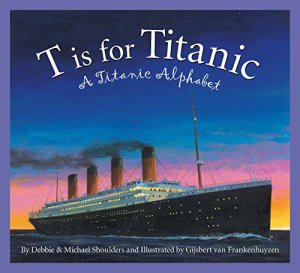
T is for Titanic is an ABC book for words from the Titanic. I have always had success with selecting a topic under study in Social Studies and having students working to create an ABC book of short paragraphs about that topic. If you have lots of time, students can work in pairs to create the book with each student doing 13 letters, but it can also be done where the class generates a list (or you do) of words that apply. Have students individually finds facts and write an interesting paragraph about the the word as applied to the topic such as the ABCs of Egypt, Haida, Japan, etc.
For more creative writing ideas, click on The Bravest Man in the World to download.

 Written in the first person, a boy tells of his simple day. First he describes the setting by the sea with a house, a road, a grassy cliff, the sea, and the town and his father digging coal under the sea. Then getting up, going to the playground, having lunch, doing an errand in town, visiting his grandfather’s graveyard and and going home, listening to the radio, having dinner, An ordinary day, and at every stage he thinks of his father digging coal under the sea.
 Gabe is a hockey player whose lucky number is 22, the same number as her hero, Hayley Wickenheiser. But her new jersey is #9. She is crushed. Gabe’s grandmother explains that the #9 was the retired number of Rocket Richard, Gordie Howe, bobby Hull, etc. and that #99 was Gretsky’s number. Gabe is reconciled, and dreams of her own retired #9.
 Max is very verbal, and his two brothers are not. Tired of his constant chatter, they obtain a wizard whose spell limits Max to 9 words. This works well for the brothers, until Queen Spark, of the land of Flint, who must be treated in a very specific way that only Max knows, visits them. Without his knowledge, war may erupt.
 Mr. Button buys a dog; Mrs. Button buys a cat. The two have conflicting habits and fight constantly until their owners bring home – a baby. The problem is solved when the cat and dog reconcile and build a home for themselves in the backyard.
 Jim is a cabin boy on the Titanic assigned to watch over a cat and her kittens. He sees the cat taking her kittens off the ship before it sails. As the “All ashore” is called there is one last kitten, so Jim takes it off and misses the ship. Based on a true story.
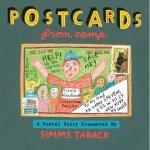 Michael hates camp and informs his father in a series of self-designed postcards of the many trials of his life there. His father returns reassuring postcards until Michael finally comes to love camp.
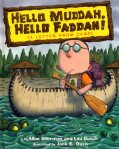 The hit parade novelty song by Allan Sherman made into a children’s book. The book tells, in song, the tale of the letter from camp, and asking his parents to please bring him home immediately. It ends with the sun breaking out and him asking his parents to “kindly disregard this letter.”
 Diana Cruchley