The Fabulous Flying Machines of Alberto Santos-Dumont

FabulousFlyingMachines_JKTThe author’s child learns in school that the Wright Brothers invented flight.  Her Brazilian husband says, “No they didn’t.  It was Alberto Santos-Dumont”.

Santos-Dumont was a wealthy Brazilian living in Paris who created the first practical dirigible and in the book uses it to go to a store, drop anchor, and go in to shop for a hat.  He then creates the first plane to fly with some controls and under its own power, as opposed to needing assistance to get into the air. Amazingly, he was also the first man to wear a wristwatch.  Clocks wouldn’t work on an airplane, so his friend, Piaget, created a small watch you could wear on your wrist.

Victoria Griffith, Abrams Books for Young Readers, ©2011, 978-1-4197-0011-8

Contrasting Two Things

The story opens with the author recounting how her child had learned in school that the Wright Brothers had invented flight, only to have her Brazilian husband point out that it was a Brazilian who flew first, and in Paris at that.

Students could read about the Wright Brothers and contrast the two.
The Wright Brothers:

  • Flew in 1903 with few witnesses vs. Santos-Dumont flying in 1905 with a thousand witnesses
  • Needed assistance—high winds and a rail system to get up speed—to get into the air vs. Santos-Dumont taking to the air under its own power.
  • Were not wealthy vs. Santos-Dumont who was wealthy
  • Had little control of the flight vs. Santos-Dumont with controls
  • Were up for 12 seconds vs. Santos-Dumont for 20 seconds
  • Had one first in their life vs. Santos-Dumont having the first practical dirigible, first unassisted flight, first mass-produced airplane (the Dragonfly), and the first person to wear a wristwatch (invented just for him).

Then ask students why they think the Wright Brothers are famous and everyone, except Brazil, has forgotten Alberto Santos-Dumont.

Teaching the Word “Irony”

Irony means to use words, and sometimes tone, to convey the opposite of what the words seem to say. For example, it is ironic to survive the San Francisco earthquake only to die in the Jamaica earthquake. It is ironic to put a “do not deface the stop sign” on the actual stop sign. In the case of this book there are two ironic statements:

  • Santos-Dumont says that airplanes will bring about peace because we will see how similar all people really are.
  • Spectators say “nobody will forget this day” when they see Santos fly.

Discuss with students the irony of these statements.

For 7 creative writing ideas, click The Fabulous Flying Machines of Alberto Santos-Dumont to download.
Chloe and the Lion

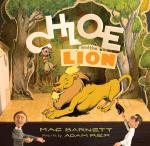
ChloeandtheLionThe author begins by presenting us with his character, Chloe, and asks the illustrator to menace her with a lion. The illustrator thinks it should be a dragon, which starts the quarrel. The illustrator torments the author sufficiently that the author fires him, and, in fact the lion the second illustrator creates eats him. Unfortunately, the second illustrator is really bad and finally Chloe and the author agree that they need to apologize to our first illustrator. They phone him, inside the lion’s stomach, and eventually he, the author, and Chloe become reunited.

Mac Barnett, Disney Hyperion Press, ©2012, 978-14231-1334-8

The Trailer

There is a great trailer that goes with the book, consisting of the further argument of the author and illustrator. I can’t decide which to do first with the students—they’re both so great. I particularly love the part where the illustrator is saying, “What is a book without the illustrator—a haiku. I’ve seen more writing on a t-shirt. That’s why they call it a ‘picture book’.”

Duck Amuck

This may not be the most academic activity but there is also a YouTube of the Looney Toons cartoon, Duck Amuck in which the character Daffy Duck attempts to play a part in the cartoon only to be erased, put in the wrong scene, coloured, blown up, etc. by the artist—who turns out to be Donald Duck. Discuss similarities and differences with the students.

For 11 creative writing ideas, click Chloe and the Lion to download.

The Extraordinary Mark Twain (According to Susy)

mark-twain-coverThis is the story of Mark Twain’s life in picture book form, with accompanying anecdotes from Susy who is writing this memoir so we can meet the “real” Mark Twain.  Susy, Mark Twain’s favourite daughter, did keep a memoir of observations of her dad for a short period of time, and excerpts from it are included as little fold out pages.  She talks about their home, his writing process and the role her mom plays, his leisure activities, and much more.

Barbara Kerley, Scholastic, ©2010, ISBN 978-0-545-12508-6

Spelling Mistakes

Mark Twain says his daughter’s spelling was frequently desperate.” Give students her spellings and ask them to spell them correctly—time them if you want to add some pressure. They need to add 5 seconds to their time for every word they still misspell.

Her incorrect words are: discribed incorectly, mustache, exept, extrordinary, sute, doute, Misouri, in good trimm, varius, chreatures (for creatures), expergate, donky, prosession.

This is a good time to mention that the first English dictionary was written in 9 years by one man, Samuel Johnson, and published in 1755. By contrast, the first French dictionary was written by an entire French Academy and published in 1694. It took 69 years to write. The first American dictionary was Noah Webster’s in 1806. After this spelling began to “solidify” into “correct” and “incorrect” spelling. Susy was writing in 1885.

A Book “In the Style Of”

This book has a particular style. For the most part it is a kind of story of Susy’s foray into biography. However, glued into place in the book are miniature foldout excerpts from Susy’s actual words. This is an excellent model to imitate.

In Social Studies it could take the form of a report on an explorer (for example) with inserted pages from his “diary” commenting on the events described on that page. In Science, it could be a report on a whale’s life cycle, with examples interspersed from the whale’s diary. In art, a research report on a particular artist could be written, with short imaginary diary inserts on occasion. Be sure that students realize the diary entries need only be 2-3 sentences long.

For 11 creative writing ideas, click The Extraordinary Mark Twain to download.

Ten Rules You Absolutely Must Not Break If You Want to Survive the School Bus

Ten-Rules-You-Absolutely-Must-Not-Break-If-You-Want-to-Survive-the-School-BusJames advises his younger brother on the 10 things you must not do if you ride the school bus.  They range from not sitting at the front, not sitting at the back, not making eye contact with the bully, to not touching the bully’s stuff, not sitting with a girl, and finally to not talking to the bus driver.  During the course of the day, his brother inadvertently breaks all 10.  But he discovers that things work out and makes a rule 11—you don’t have to pay attention to the rules.

John Grandits, Houghton Mifflin, ©2011, 978-0-618-78822-4

Listening Idea

With the PDF of lesson ideas there is a listening chart with the 10 rules cited on it. The second time you read the story, students could note how these rules are broken. Discuss at the end. For each one, ask if it is a sensible rule and why.

Similes

This is a good time to teach students the structure of a simile. Each of the 7 similes in the book is reflected in the illustration, which cleverly reflects the perception of the narrator. You may want to project the illustrations as you point out the similes in the book and ask the students to discuss their meaning. The only simile missing is that of the bus driver, although the illustration of her is of a predator bird. The similes are:

  • a dog…sounded like an arctic wolf that hadn’t eaten all winter
  • school bus …charging at me like a giant yellow rhinoceros
  • staring at me…I felt like a zebra at a lion party
  • big kid…up close, he was the size of a grizzly bear
  • girls…as mean as snakes
  • bus driver…illustration of a predator bird, no simile
  • brother…jumping up and down like a spider monkey.

For 7 creative writing ideas, click Ten Rules to download.

Bridget’s Beret

beretBridget’s loves to draw and is inspired by her beret. Unfortunately one day the beret blows away, and Bridget resorts to many other types of hats. None of them is inspiring. She is suffering from “painters block” until one day her friends who are opening a lemonade stand need a sign.. Bridget makes a series of signs (in the style of Whistler’s Mother, Van Gogh’s Starry Night, Andy Warhol’s Tomato Soup etc.). Her signs are viewed as an outdoor exhibit as passers by purchase lemonade at the “refreshment stand.” Of course, it ends with Bridget re-inspired to paint. This book also includes 2 pages of How to Start Your Art.
Tom Lichtenheld, Henry Holt, ©2010, 978-8-8050-8775-8

Artist Study Inspired By the Book

The following artists are mentioned in the back pages of the book or illustrated in the book itself: Monet, Cezanne, Georgia O’Keefe, Henri Matisse, Alfred Sisley, Guisseppe Arcimbolda, Mary Cassatt, Vincent Van Gogh, Georges Seurat, Rembrandt, Pablo Picasso, Andy Warhol, James Whistler.

Here’s a rapid research task for your students. Each pair of students would have 1 hour of computer time and an hour to write their product for presentation. For each artist they need to find a sample piece of art, 10 facts about the artist and 5 important facts about the piece of art (not including its title).

For general cultural literacy, and to meet one of the learning outcome for art, they would present their findings as a poster with the art piece pasted in place, or a PowerPoint oral presentation with illustrations.

Hats and Vocabulary

Bridget tries on a coonskin cap, a propeller beanie, a fez, a cowboy at, a fishing hat, a baseball cap, a gardening hat, and a pith helmet without success. To build vocabulary this is a good time to learn to name the many different kinds of hats there are.

A page of hat pictures is included with the pdf of teaching ideas. First students would study the hats with the key. Then, print on card stock a single sheet for every two students and ask them to cut them up to make sets. Students take turns timing each other to see who can name them the fastest, keeping in one pile the ones they get right, and in another the ones they get wrong.

For 7 creative writing ideas, click Bridget’s Beret to download.

Mr Maxwell’s Mouse

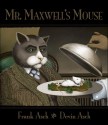
maxwellmouseAt the Paw and Claw restaurant it is lunch and Mr. Maxwell wants to celebrate his promotion with something special. He orders the headwaiter, Clyde to bring him a live mouse instead. When Clyde asks “Would you like us to kill it for you?” Mr. Maxwell replies, “That won’t be necessary.”
But his decision results in a mouse with excellent manners slowly undermining his desire to kill it. The mouse speaks for one thing, has excellent manners, suggests salt and pepper, requests that grace be said, suggests and appropriate wine, and so on.

How the mouse gets out of it is very reminiscent of other “escape” stories including the fairy tale Three Billy Goats Gruff.

Frank and Devin Asch, Kids Can Press, 2004, ISBN 978-1-55337486-2

Food Advice From Your Parents

Mr. Maxwell’s mother had always said, “Don’t fraternize with your food.” Use this as a starting point to a discussion of advice, rules, and sayings about food that the students have from their parents. Ask them to brainstorm at least six sayings and be prepared to present the logic behind the sayings.

  • Don’t play with your food
  • Don’t chew with your mouth open
  • Eat everything on your plate
  • Just try it
  • Don’t bit off more than you can chew
  • As easy as apple pie
  • It’s a piece of cake
  • It’s like taking candy from a baby
  • It’s good for you
  • A dish fit for a king
  • As alike as two peas in a pod
  • A watched pot never boils
  • Man does not live by bread alone
  • Take that with a pinch of salt
  • You are what you eat

A story where one character persistently offers “food” sayings and advice to the other character might be fun if students are enjoying this activity. (Perhaps a frog that is trying rather unsuccessfully to catch flies while his little friend is continually offering advice.)

The Note of Apology

At the end of the book the mouse sends a note of apology to Mr. Maxwell. Analyze it with the students to identify its characteristics, before they practice an imaginary apology themselves. It might be fun for them to write a story that is actually an extended apology for a whole series of mishaps.

Characteristics students might identify could include:

  • It must be sincerely felt and must include the words “I am sorry” or “I apologize.”
  • The apology cannot be followed by the word “but…”
  • It should be short (but not if it is actually a disguise for a story).
  • It should identify the thing(s) that happened and what you are apologizing for.
  • It should offer to make up for it in some way, if possible.
  • It should end with the hope for the future
  • It needs to include a salutation, and an ending. Dear…and Sincerely…

With the criteria the students identify, how good is the mouse’s apology?

For 10 creative writing ideas, click Mr. Maxwell’s Mouse to download.

Rumpelstiltskin’s Daughter

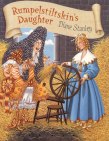
rumpelstiltskinThis fractured fairy tale begins after “Meredith” marries Rumpelstiltskin instead of the king and they have a daughter, Hope. Occasionally Rumpelstiltskin spins some gold and Hope takes it to the village. On hearing of it, the king captures her and demands she spin gold. She says she is not sure, but believes her grandfather did it with wheat. So it is planted across the kingdom. The peasants are happy, but the king still wants gold. Next, they try gold wool—again, the peasants are happy, but the king wants gold. Eventually, Hope becomes Prime Minister and, whenever the king becomes anxious, she takes him on a goodwill tour of his now happy kingdom.

Diane Stanley, ©1997, Harper Collins, ISBN 0-688-14327 – X

Parodies of Art

On the wall in the king’s castle are several clever parodies of some famous paintings. Since awareness of famous art and artists is part of the art curriculum, a study of the 8 pictures that are easily identified could be fun. Give each group of students a photocopy of one of the parodies from the book. Then give them a photocopy of the original piece of art, its name, and artist.

Ask students to prepare a one page “poster” on their picture. The poster would include both illustrations along with several paragraphs on the artist’s life, and a paragraph on the piece of art. Why was it created, when, for whom, where it is now, what is it a picture of, etc.?

Explain that an art reference “joke” like this is a literary reference—it is hard to get the joke without background knowledge. You can even talk about how there are a lot of “in jokes” that young people would not get in a movie like Shrek, but that adolescents and adults have background knowledge to catch the reference.

The pictures in the book are:

  • Mona Lisa, Leonardo da Vinci
  • Birth if Venus, Botticelli
  • Laughing Cavalier, Frans Hals
  • Starry Night, Vincent Van Gogh
  • Seated Woman with a Wrist Watch, Pablo Picasso
  • George Washington, John Trumbell
  • Whistler’s Mother, James McNeil Whistler
  • Frederico de Montefeltro, Piero della Francesca

Compare the Tales

Working in pairs, ask students to generate the longest possible list of the characteristics the three stories they have in common—the original Rumpelstiltskin’s fairy tale, the version where Meredith marries Rumpelstiltskin instead of the ing, and the story of her daughter Hope. They should find at least the following qualities:

  • Rumpelstiltskin
  • Meredith
  • The King
  • The request to spin gold
  • The threat of death
  • The promise of marriage
  • Three tries
  • The palace

Students can also be asked to write their comparison when they have completed their list.

For 6 creative writing ideas, click Rumpelstiltskin’s Daughter to download.

School For Bandits

School_For_Bandits_PB_CoverRalph Raccoon is too polite and too nice. His parents have to send him to Bandit School to learn to be a proper bad raccoon. How does Ralph use his “niceness” to succeed?
Hannah Shaw, Alfred A. Knopf, ©2011, 978-0-375-96768-9

Synonym Study

There are many synonyms for people who take things that don’t belong to them. Students might find: pirate, thief, robber, buccaneer, brigand, cheat, crook, con artist, rustler, looter, pilfereer, shoplifter, gangster, highwayman, raider, racketeer, etc. This could also be a good brainstorming activity to build vocabulary.

Once they have a list, ask them to define each one in such a way that people could read the list of definitions and know what each word was being referred to.

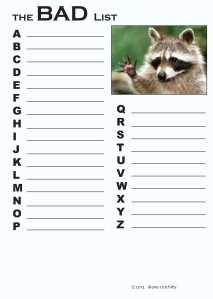
School-For-Bandits-bad-listThe Being Bad Alphabet

Ralph Raccoon hasn’t been bad enough so he has to brainstorm 26 words (one for each letter of the alphabet) that are ways of being bad. A could be for aggravating, B for bragging, C for cursing, and so on. X and Z are notoriously hard—encourage students to use two words if necessary to get them in. Examples: eXtra Noisy or Zealously irritating.

This can be an individual activity or a brainstorming activity to build vocabulary.

For 6 creative writing ideas, click School For Bandits to download.

The Very Smart Pea and the Princess To Be

princessandpeaThe pea under the mattress writes a memoir of his attempt to help the prince find a “real princess.” Eventually the gardener’s girl who raised the pea lies on the twenty mattresses and he whispers, “You are very uncomfortable,” in her ear all night. She repeats this to the queen in the morning and marries the prince. The pea lives on in the royal museum.

Mini Grey, Alfred A. Knopf ©2003 ISBN 0-375-82626-2 (trade) and 0-375-92626-7 (library)

Fairy Tale Recipe Book

The pea is brought to the palace for a special recipe of Pea and Raspberry Jelly.  Why not use this as an opportunity to create a Fairy Tale cookbook?

First collect about six recipes from different cookbooks with different formats. Make copies for each group of 4 students and ask them to identify the critical elements of a recipe. They should come up with: title, ingredients list with the measurements needed, the temperature of the oven, step by step instructions, length of cooking at what temperature, preparing the pan (grease, lined, etc.), how many it serves, and so on.

Students can then brainstorm appropriate recipes for different fairy tales: Gingerbread Boy’s Gingerbread – Run Away Good, Goldilocks “Just Right” Porridge, Snow White’s Candied Applies, Cinderella’s “Fits Right” Pumpkin Pie, and so on.

You could create a class book of recipes where each page has: a picture of the cover of a sample fairy tale book, a 10 line summary of the story, and the recipe with its new Fairy Tale title. Suggestions for occasions to serve it would be great. Putting the finished bound book in the library can be great.

My Artefact

The pea becomes an “artefact” in the royal museum. The word comes from the Latin meaning “arte” (by hand) and “fact” (an object). An artefact is any human-made object which illustrates something about a culture. It is studied by archeologists and often displayed in museums. In fantasy games, an artefact is an object from a long lost culture that has magic powers. Your class constructs a “museum” of of artefacts from their year—posters of favourite songs, favourite commercials, favourite activities, school events, favourite foods, etc. Alternatively, a class museum can be constructed as each student brings an artefact that has associations for him/her and displays it with a poster explaining its “archeological meaning” from their life.

For 5 writing ideas, click Princess and the Pea to download.

The Plot Chickens

The Plot ChickensHenrietta, the chicken, loves to read and decides to write a book for herself.  Having trouble getting it published, she self-publishes, but is sad after a bad review in the “Corn Book”.  She is depressed until she discovers that children love her book.

Mary Jane and Herm Auch, Holiday House, ©2009, ISBN 13:978-0-8234-2087-2

Eight Rules to a Great Story

The Plot Chickens provides 8 great rules for writing a great story, as Henrietta slowly writes her own book. Read the story to the students, and then ask them during the second reading, to take notes for themselves on what the 8 Rules for Great Writing are. In Classroom Instruction That Works, Robert Marzano says that note making is one of the top two strategies that can be directly linked to student achievement.

Vocabulary of Paper and Printing

In the full PDF version of the writing tips for The Plot Chickens, there is a black line master for an activity to teach students the names for 11 different types of paper. Create 8 sets of papers (each about 10 cm by 10 cm) and number them in a random order. Keep the key at the desk, as they try to identify the papers using the black line master. When they have them all, collect the black line master, and ask them to write down, in order, the names of the 11 sample papers you have given them.

Students can also learn the printing terms that have moved into regular word processing…these are words that just a few years ago, only trained printers knew, but now everyone is mastering. Sample words might be: clip art, collate, crop, font, italic, bold, 12 point (well, that point means size of the letter), typo, bullet, template, justified, ragged right (where it is justified on the left but uneven on the right), cyan (blue), magenta (dark red).

For 10 writing ideas, click The Plot Chickens to download.