 The story of Hansel and Gretel as told by Gretel, in her own voice and with her point of view. A very clever pop-up story—and a potential model for student pieces.
Kees Moerbeek, ©2002, Simon and Schuster, ISBN 0-689-84602-9
Write a Point of View
Any of the fairy tales, or indeed a part of any novel, or a historic event, can be rewritten into the form of a diary of one of the characters. In this way, the character can be given his or her own peculiar qualities that can come our in the telling. In this story, Gretel is just a little acerbic. She doesn’t have much confidence, deservedly, in her brother Hansel but she loves him and saves him anyways.
Students can take a fairy tale and and rewrite it from the point of view of one of the characters. Cinderella;s story could be told from the point of view of one of the stepsisters, or one of the mice, to the fairy godmother. The fairy godmother, for example, might think that Cinderella is a little bit of a whiner—always calling for help and crying instead of helping herself.
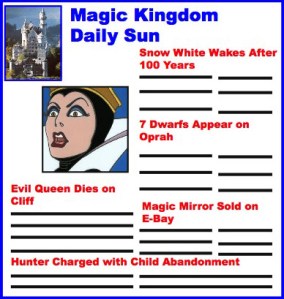
Creating a Mock Newspaper
A mock newspaper story is a great time to teach how to write a newspaper story. Elements that matter are that the paragraphs are short with only one or two sentences. The lead paragraph contains the who, what, where, when, why, and how of the story. Quotes of in the middle. It should be able to cut from the bottom to fit in the newspaper.
Working in teams of 4–5, students can choose a fairy tale then write an entire front page of newspaper stories that might emerge from the fairy tale they have chosen.
For 5 writing ideas, click Diary of Hansel and Gretel to download.
 This one is my own book, which I’m quite thrilled with. It follows four characters—the beaver, Jon, Jesse, and Max—as they adventure with a Canadian science invention or discovery for each letter of the alphabet. From A is for Acetylene to Z is for Zipper (or B is for Blackberry to Y is for Yukon Gold Potato), Canadians are totally inventive. This title has been authorized for use in both BC and Alberta and is intended for Grades 4–9.
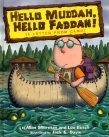 The hit parade novelty song by Allan Sherman made into a children’s book. The book tells, in song, the tale of the letter from camp, and asking his parents to please bring him home immediately. It ends with the sun breaking out and him asking his parents to “kindly disregard this letter.”
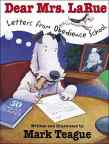 Ike is sent to Obedience School because he misbehaves. Read his heartrending letters to his master in this witty story. With each letter, see the luxury in which he is really living, with the black and white picture of what he is writing about. Ike eventually escapes, returns home, and rescues his owner.
 Henrietta, the chicken, loves to read and decides to write a book for herself. Having trouble getting it published, she self-publishes, but is sad after a bad review in the “Corn Book”. She is depressed until she discovers that children love her book.
 In the country, in modern Japan, a little old couple lives quietly. The man says he misses his “rounds” (we don’t know what they are) and his wife makes him some candies so he can go into town on his bicycle and repeat what he used to do. He bicycles through busy streets to where the park used to be and sets up a little theatre. He recalls to himself what it was like to entertain crowds of children with his Japanese tales until television came. Coming out of his reminiscence he sees a crowd has gathered to hear these traditional tales and he gives out the candy his wife made.
 The legend behind the Blue Willow is the story of a girl who falls in love with a poor fisherman. Her father places obstacles in their path. First he says to wait until the fall, then until he finds money in the street then when a rainbow appears over the pavilion. Finally the daughter dies while looking for her lover at sea during a storm. When her fisherman lover discovers her death, he cries out in anguish and is killed by the villages mistaking him for a screaming tiger. The rainbow and dove appear over the daughter’s pavilion. The father commissions the plate in memory of the two lovers.
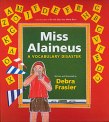 Sage is home sick, but she is trying to continue with her vocabulary homework. It goes awry when she mistakes miscellaneous for Miss Alaineus. Her mother is holding a box with spaghetti hair on it when she mentions she needs “miscellaneous things” from which Sage concludes she is the woman on the box. When she defines it that way, the whole class laughs. Sage is devastated until she ends as Miss Alaineus, Queen of All Miscellaneous Things at the Vocabulary Parade. This book is full of charming puns and built in word definitions.
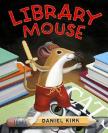 Sam, the Library Mouse, lives in the reference section and reads all the genres in the school library. One day he decides to write his own miniature book – a biography. His next is a mystery, then a full chapter book. He sneaks them onto the shelves in the correct library section and slowly develops “fans”. The librarian invites him to do an author reading but Sam knows he can’t. He solves the problem by making a pile of blank miniature books. Then he wraps a Kleenex box with a sign saying, “Meet the Author”. When students look in, they see their own face in the mirror he placed in the box.
 Diana Cruchley