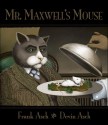
 At the Paw and Claw restaurant it is lunch and Mr. Maxwell wants to celebrate his promotion with something special. He orders the headwaiter, Clyde to bring him a live mouse instead. When Clyde asks “Would you like us to kill it for you?” Mr. Maxwell replies, “That won’t be necessary.”
But his decision results in a mouse with excellent manners slowly undermining his desire to kill it. The mouse speaks for one thing, has excellent manners, suggests salt and pepper, requests that grace be said, suggests and appropriate wine, and so on.
How the mouse gets out of it is very reminiscent of other “escape” stories including the fairy tale Three Billy Goats Gruff.
Frank and Devin Asch, Kids Can Press, 2004, ISBN 978-1-55337486-2
Food Advice From Your Parents
Mr. Maxwell’s mother had always said, “Don’t fraternize with your food.” Use this as a starting point to a discussion of advice, rules, and sayings about food that the students have from their parents. Ask them to brainstorm at least six sayings and be prepared to present the logic behind the sayings.
- Don’t play with your food
- Don’t chew with your mouth open
- Eat everything on your plate
- Just try it
- Don’t bit off more than you can chew
- As easy as apple pie
- It’s a piece of cake
- It’s like taking candy from a baby
- It’s good for you
- A dish fit for a king
- As alike as two peas in a pod
- A watched pot never boils
- Man does not live by bread alone
- Take that with a pinch of salt
- You are what you eat
A story where one character persistently offers “food” sayings and advice to the other character might be fun if students are enjoying this activity. (Perhaps a frog that is trying rather unsuccessfully to catch flies while his little friend is continually offering advice.)
The Note of Apology
At the end of the book the mouse sends a note of apology to Mr. Maxwell. Analyze it with the students to identify its characteristics, before they practice an imaginary apology themselves. It might be fun for them to write a story that is actually an extended apology for a whole series of mishaps.
Characteristics students might identify could include:
- It must be sincerely felt and must include the words “I am sorry” or “I apologize.”
- The apology cannot be followed by the word “but…”
- It should be short (but not if it is actually a disguise for a story).
- It should identify the thing(s) that happened and what you are apologizing for.
- It should offer to make up for it in some way, if possible.
- It should end with the hope for the future
- It needs to include a salutation, and an ending. Dear…and Sincerely…
With the criteria the students identify, how good is the mouse’s apology?
For 10 creative writing ideas, click Mr. Maxwell’s Mouse to download.
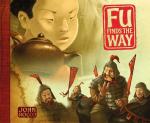 Fu is planting rice and is bored enough not to be doing it well, in neat rows. When he is rebuked, he throws a rice plant out of the paddy into the path of the warrior, Chang. The insulted warrior challenges him to a duel. Fu finds the sword Master and asks for help in getting ready. Through the night, all the Master does is teach him how to make and pour tea – with Purpose, Flow, and Patience. When Fu faces Chang in the morning he faces him with a teapot and suggests a pot of tea. Chang’s followers laugh at the boy, but Chang says, “There’s always time for tea.”
 Henrietta loves to read and has hardly any time to lay eggs. The farmer says he is sending all the rest of the hens on a vacation as a reward for their hard work. As they leave, Henrietta reads the words on their truck which say, “ Souper Soup Company” and realizes her friends are headed for the soup. Along the road to rescue them she hitchhikes pigs and cows. At the factory she reads the signs in the hallways to find the chickens, reads the code to find the address, and, after the rescue, finally discovers in a magazine a vegetarian farm where they can live.
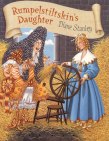 This fractured fairy tale begins after “Meredith” marries Rumpelstiltskin instead of the king and they have a daughter, Hope. Occasionally Rumpelstiltskin spins some gold and Hope takes it to the village. On hearing of it, the king captures her and demands she spin gold. She says she is not sure, but believes her grandfather did it with wheat. So it is planted across the kingdom. The peasants are happy, but the king still wants gold. Next, they try gold wool—again, the peasants are happy, but the king wants gold. Eventually, Hope becomes Prime Minister and, whenever the king becomes anxious, she takes him on a goodwill tour of his now happy kingdom.
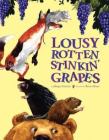 A wonderful retelling of the Aesop fable where the fox makes frequent attempts to get at the grapes until he finally says that they are probably sour anyway. Hence the expression “sour grapes”.
 Huckleberry Finn tells, in his own voice, of the life of his author Mark Twain, a.k.a Samuel Clemens.
 This is the story of fishermen who are caught in a huge wave that deposits a baby into their arms. He grows up uncertain as to where he comes from or who his real parents are. A fish promises to help him answer his questions. When the boy finally becomes scared, the fish turns into a dragon and says that Naoki now knows that his “real” parents are the ones that raised him.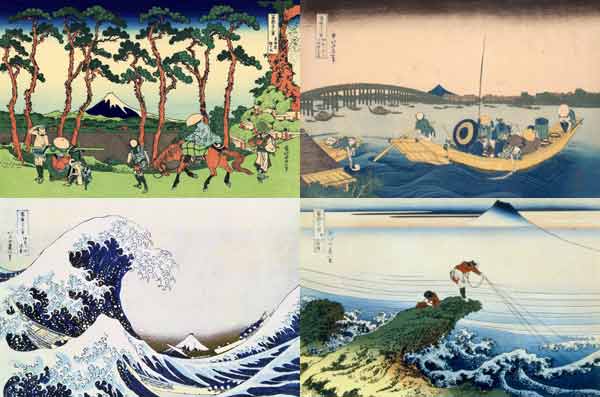
 Ralph Raccoon is too polite and too nice. His parents have to send him to Bandit School to learn to be a proper bad raccoon. How does Ralph use his “niceness” to succeed?
 The Being Bad Alphabet
 Annie Taylor was the first person to go over Niagara Falls in a barrel, the first to survive, the first woman for over 95 years, and the only woman to do it alone. This is her story – the story of a woman over 60 years of age who did an amazing thing.
 The pea under the mattress writes a memoir of his attempt to help the prince find a “real princess.” Eventually the gardener’s girl who raised the pea lies on the twenty mattresses and he whispers, “You are very uncomfortable,” in her ear all night. She repeats this to the queen in the morning and marries the prince. The pea lives on in the royal museum.
 Diana Cruchley