 This book is not new, but has been recently re-issued, so I am including it because it is great for writing ideas. The Quiltmaker makes quilts only for the poor. When the king covets one she refuses, but will make one square for each gift he gives away. After several threats, he gives in, and finds that giving to others is where he find happiness.
Jeff Brumbeau, Scholastic, ©2001, ISBN 0-439-30910-7
The Pattern Story
The quilting patterns shown on the 32 pages of the book have been chosen to echo the part of story told on each page. Give each student a page and a copy of the patterns in the book (on the inside covers.) First they find their pattern, and its name. Then they develop an explanation of why that pattern has been chosen for that page. Create a quick PowerPoint showing each of pages and a close-up of each of the patterns in order. Finally, you read the story (or students read the story), page by page. As each page is read, show the pattern. At the end of that page, a student explains the pattern and why he/she feels it was chosen for the page. There are 23 patterns in total, so some of the students will need to “double up” if you have a larger class. (The key to the match of the pattern to the page is included in the PDF you can download for this book.)
Vocabulary of Shimmer
In describing the king’s storehouse of gifts, the author says they “shimmer”. Ask students to brainstorm words that mean to reflect or give off light. Some words they may come up with are: shimmer, glitter, sparkle, glow, flash, shine, twinkle, scintillate, radiate, dazzle, glint, glisten, beam, emit, gleam, glare, etc. Give students a pair of words and ask them to tell you the difference—ie. shimmer vs glare or twinkle vs. gleam. Then ask them to arrange the words from least amount of light to most amount of light. In general, playing with the words solidifies the vocabulary.
For 10 creative writing ideas, click The Quilt Maker’s Gift to download.
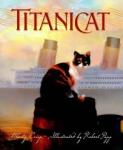 Jim is a cabin boy on the Titanic assigned to watch over a cat and her kittens. He sees the cat taking her kittens off the ship before it sails. As the “All ashore” is called there is one last kitten, so Jim takes it off and misses the ship. Based on a true story.
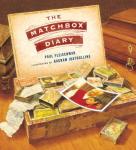 Grandfather has a room full of treasures, each with a story attached. She asks for the story of the cigar box filed with matchbooks, each with a tiny symbol of a story from grandfather’s life.
 The biography of the ancient Greek mathematician and librarian who measured the circumference of the earth, with an error of only 200 miles, at a time when people didn’t even know for sure the earth was round, using math alone.
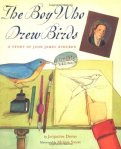 James Audubon was French, and was sent to America to learn business, and also to avoid French military service in Napoleon’s army. While there, he became passionate about the observation and detailed paintings of birds. This is his story with particular emphasis on his “test” of migration.
 Naturalists study nature the way it is rather than the way theories say it is. As a result, going back to Aristotle, there has been steady progress in science because of the work of naturalists. The attached pages describe 17 naturalists and their contributions to the study of the real world. This can be a great Rapid Research project to build general knowledge about history (useful as well in building vocabulary), speaking and writing skills, and, of course, research skills.
 The Queen is coming to Littleton and Miss Hunnicutt wants to wear her hat with a chicken on top. After she stands up for her right to wear what she wants, we discover that the Queen loves her hat with the turkey on top.
 Ask students to choose one to research (in pairs). The team needs to produce 12 facts about the artist, and 6 facts about the painting (where it is located, size, and, the model, the hat, etc.)
 This is a picture book version of Jerry Seinfeld’s wonderful routine on what Halloween was like to him as a child.
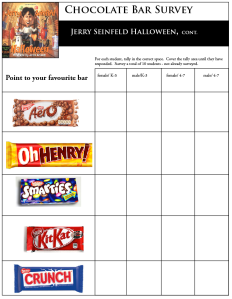 The Candy Vote
 This little 48 page book, part of the Treasure Hunters series describes several major art thefts since the beginning of the 20th C. The Mona Lisa, many paintings in the Isabella Gardner Museum, Munch’s The Scream, and a painting by Cezanne are all included.
 Latitude and Longitude are just imaginary lines on the surface of the earth, but are critical to navigation. Latitude (north and south) was known, but it wasn’t until John Harrison (a clockmaker) tackled it in the 1700’s in order to win a prize, that the problem was solved.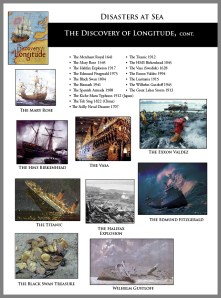
 Fibonacci was part of the revolutionary change from Roman numerals to Arabic numerals in the 12th century. His most important contribution to math is the Fibonacci sequence, which this book explains.
 Astonishingly, nature uses these numbers all the time…in flower petals, seeds inside, starfish, 3 leaf clovers, 8 sections in a lemon, etc. Even humans have 1 head, 2 eyes, 5 fingers, etc.
 Diana Cruchley