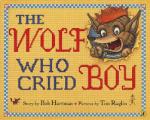
 Little Wolf never likes what is made for dinner: Lamburgers, Sloppy Does, Chocolate Moose—nothing pleases him. All he can think about is “boy”—boy chops, baked boy-tatoes and boys -n-berry pie. On the way home to three pig salad, Little Wolf has the idea of pretending to see a boy. After this trick results in him getting junk food for several nights, his father overhears him bragging to a friend. They refuse to listen to him…even though he has seen an entire troop of boy scouts in the woods, and one even enters the cave. Lesson learned, and the boys, at least, live happily ever after.
Bob Hartman, GP Putnam, 2002, ISBN 0-399-23578-7.
Wolf Variations
Students should be able to draw the comparisons between this story and the original Boy Who Cried Wolf. If you read them the original story and then this one, they should be able to construct a VENN diagram to compare and contrast the two stories (see the blackline master).
Then you could ask them to brainstorm other stories into which a wolf variation could be included: Chicken Wolf (from Chicken Little), Little Red Wolf (from the Little Red Hen), Wolf and the Beanstalk (from Jack and the Beanstalk – although it will be hard for a wolf to climb), etc. They could then try to write a new a clever version of the story with the wolf as a main character.
Fairy Tales and Fables With Wolves
Many fairy tales, particularly “northern” tales feature wolves…possibly because they were a real danger in the time of the stories. Many of Aesop’s fables also feature wolves, which makes one think that perhaps this is one of the dangers in Greece at the time of Aesop as well.
A list of tales you may wish your students to read and discuss includes:
- Little Red Riding Hood (Grimm fairy tale)
- The Three Little Pigs (Grimm fairy tale)
- The Wolf and the Seven Young Kids (Grimm fairy tale)
- The Dog and the Wolf (Aesop)
- The Wolf and the Lamb (Aesop)
- The Wolf and the Crane (Aesop)
For 5 creative writing ideas, click The Wolf Who Cried Boy to download.
 Our illustrator is racing through the book trying to tell the story of a pie-loving king who has imprisoned his stepdaughter. He will only release her when a suitor kills the dragon. We, “the readers”, are reading too fast for the illustrator to keep up. This results in emergency art substations that detour our plot.
 The author’s child learns in school that the Wright Brothers invented flight. Her Brazilian husband says, “No they didn’t. It was Alberto Santos-Dumont”.
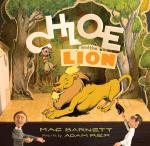 The author begins by presenting us with his character, Chloe, and asks the illustrator to menace her with a lion. The illustrator thinks it should be a dragon, which starts the quarrel. The illustrator torments the author sufficiently that the author fires him, and, in fact the lion the second illustrator creates eats him. Unfortunately, the second illustrator is really bad and finally Chloe and the author agree that they need to apologize to our first illustrator. They phone him, inside the lion’s stomach, and eventually he, the author, and Chloe become reunited.
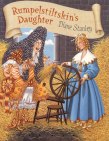 This fractured fairy tale begins after “Meredith” marries Rumpelstiltskin instead of the king and they have a daughter, Hope. Occasionally Rumpelstiltskin spins some gold and Hope takes it to the village. On hearing of it, the king captures her and demands she spin gold. She says she is not sure, but believes her grandfather did it with wheat. So it is planted across the kingdom. The peasants are happy, but the king still wants gold. Next, they try gold wool—again, the peasants are happy, but the king wants gold. Eventually, Hope becomes Prime Minister and, whenever the king becomes anxious, she takes him on a goodwill tour of his now happy kingdom.
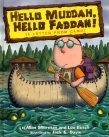 The hit parade novelty song by Allan Sherman made into a children’s book. The book tells, in song, the tale of the letter from camp, and asking his parents to please bring him home immediately. It ends with the sun breaking out and him asking his parents to “kindly disregard this letter.”
 Diana Cruchley