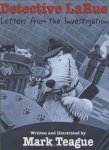
The follow-up book to Dear Mrs. LaRue, using the same pattern, finds Ike accused of abducting the neighbour’s cats. Mrs. LaRue is on vacation, and the story proceeds through his letters from jail, and on the road, as he tracks down the culprits. As with the other book, his letters in black and white show the difficulties he is claiming to have; the coloured pictures show the reality of his experience.
Mark Teague, Scholastic, ©2004, ISBN 0- 439-45868-4
The Letter Story
This book can provide an excellent model for telling a story that advances through a series of letters. Ask students to first outline a story they wish to write, then to add rich details in the form of a series of letters home, or to a friend, or someone who has moved a way, telling a bit of the story in each letter.
The Point of View Story

Each page of the book contrasts black and white with colour. The black and white portion of the picture represents how Ike is seeing the situation. In the first letter he is seeing himself as sitting in a bare cell, singing with a rat, with a metal tin, presumably having held food on the floor, looking pathetic. In the colour picture, he is sitting at the officer’s desk, with dog bones and a doughnut, drinking a coffee the officer has presumably poured, while typing his letter on the officer’s typewriter.
This is an excellent model for two perspectives on any historic Social Studies event being studied. For example, on one side of the page of a report on Columbus, students could write the historic story of Columbus. On the other side, the same story from the point of view of the miserable sailor who is suffering from sea sickness, shortage of food, scummy water, scurvy, crowded conditions, etc.
Did you know, for example, that the three ships of Columbus were actually the Nina, the Pinta, and the Navidad. Apparently, on Christmas the crew was drunkenly celebrating and a sailor ran the Santa Maria aground. They built a new ship from scavenging the old one, and anything else they could find and christened it The Navidad (for the name of Christmas in Spanish.) It would make a great letter.
YouTube Reading Rockets
An interview with Mark Teague about his early writing experiences is available at YouTube Reading Rockets where he describes dictating stories to his mom. It’s very short…and might make a really good prompt to students writing a journal entry about their earliest writing experiences.
For 10 creative writing ideas, click Detective LaRue 2pdf to download.
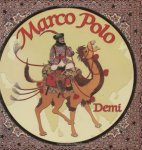 The story of Marco Polo and his trip from Venice to Beijing starting in 1271 and his return 24 years later. The illustrations are in an eastern 13th century style, with gilding and gorgeous elaborate borders all using Chinese inks. Be selective in your choices of what you read – it is a long picture book.
 Gabe is a hockey player whose lucky number is 22, the same number as her hero, Hayley Wickenheiser. But her new jersey is #9. She is crushed. Gabe’s grandmother explains that the #9 was the retired number of Rocket Richard, Gordie Howe, bobby Hull, etc. and that #99 was Gretsky’s number. Gabe is reconciled, and dreams of her own retired #9.
 A delightful ABC book of circus anecdotes principally focusing on the most famous acts of Barnum and Bailey. It is all done in the style of the big circus posters of the 30’s advertising the next circus to come to town. Visually gorgeous.
 Mr. Button buys a dog; Mrs. Button buys a cat. The two have conflicting habits and fight constantly until their owners bring home – a baby. The problem is solved when the cat and dog reconcile and build a home for themselves in the backyard.
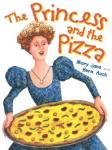 The king has given up his kingdom and his daughter decides to try to marry Prince Drupert so she enters the competition for his hand. During the food portion of the competition she accidentally invents pizza and discovers that she would rather sell pizza than marry the prince.
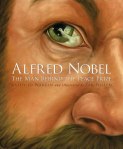 Alfred Nobel invented dynamite and became very wealthy. Saddened by its us in war he left his entire fortune to a yearly prize for those “who have rendered the greatest services to mankind.”
 How Gutenberg Changed the World. Illustrated like a medieval manuscript, the book shows how all the parts of the process came together to create the first printing press.
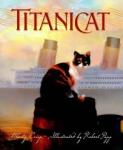 Jim is a cabin boy on the Titanic assigned to watch over a cat and her kittens. He sees the cat taking her kittens off the ship before it sails. As the “All ashore” is called there is one last kitten, so Jim takes it off and misses the ship. Based on a true story.
 The biography of the ancient Greek mathematician and librarian who measured the circumference of the earth, with an error of only 200 miles, at a time when people didn’t even know for sure the earth was round, using math alone.
 Diana Cruchley