 Night Flight has few words. It concentrates on just 14 hours and 56 minutes of time, starting in the evening from Harbour Grace in Newfoundland on May 20th, 1932, and ending in Ireland. The author recreates the experience in vivid descriptive language of what she had to do to stay awake, storms, failure of equipment, flying through the night. The author also describes what is seen from the plane as she left, during the night, flying over tundra, approaching land in Ireland. Imagine the Irish farmer coming toward this strange vehicle that had landed in his field, and the woman waving and saying, “I’ve come from America.” Amazing.
Robert Burleigh, Simon and Schuster, ©2011, 978-1-4169-6733-0
Talking With Amelia Earhart
The back of the book has many quotes from Amelia Earhart that are worth discussing with students, or using as prompts for journal writing:
- Courage is the price that life exacts for granting peace.
- I prefer good mechanical work to rabbits’ feet.
- I could not see. I carried on.
- Everyone has their own Atlantic to fly. Whatever you want very much to do, against the opposition of tradition, neighbourhood opinion, and so-called common sense—that is an Atlantic.
- One of my favourite phobias is that girls, especially those whose tastes aren’t routine, often don’t get a fair break.
- The most effective way to do it, is to do it.
Journal Writing
Having students draw from their own experience is a good way to get a journal response to a piece of
writing. Here are some possibilities:
- Amelia had to stay awake a long time. Describe a time when you were up very late. Did you have to do anything special to stay awake?
- Amelia was caught in a lightning storm. Describe an experience you had with a storm?
- Amelia had to be well prepared, but still incredibly brave. Describe a time when you prepared very well for something and then did it.
For 8 creative writing ideas, click Night Flight to download.
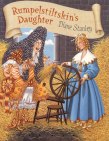 This fractured fairy tale begins after “Meredith” marries Rumpelstiltskin instead of the king and they have a daughter, Hope. Occasionally Rumpelstiltskin spins some gold and Hope takes it to the village. On hearing of it, the king captures her and demands she spin gold. She says she is not sure, but believes her grandfather did it with wheat. So it is planted across the kingdom. The peasants are happy, but the king still wants gold. Next, they try gold wool—again, the peasants are happy, but the king wants gold. Eventually, Hope becomes Prime Minister and, whenever the king becomes anxious, she takes him on a goodwill tour of his now happy kingdom.
 In the country, in modern Japan, a little old couple lives quietly. The man says he misses his “rounds” (we don’t know what they are) and his wife makes him some candies so he can go into town on his bicycle and repeat what he used to do. He bicycles through busy streets to where the park used to be and sets up a little theatre. He recalls to himself what it was like to entertain crowds of children with his Japanese tales until television came. Coming out of his reminiscence he sees a crowd has gathered to hear these traditional tales and he gives out the candy his wife made.
 Diana Cruchley