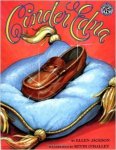
 Cinder Edna is the liberated neighbour of Cinderella. Cinderella needs a fairy godmother to get her to the ball; Cinder Edna earns money mowing lawns and cleaning parrot cages. She earns enough for the dress, wears comfortable loafers to the ball, and takes the bus. She gets the best prince too—the brother of the one Cinderella marries.
Ellen Jackson, Mulberry Books, 1998, ISBN 0688162959
Here It Is, and Again, and Again.
A turning point in the story is going to be that Cinder Edna knows 16 ways to make tuna casserole. The fact is planted in the story when we first meet her and it is listed as one of her skills. It is mentioned again when she meets Rupert and discovers he likes tuna casserole too. Finally, Rupert uses the 16 types of tuna casserole to determine which is the real Cinder Edna.
This is a really great skill to teach students when writing a story. When you have decided on the solution to your problem, you can plant it into the story three times—the first two quite unobtrusively. It makes the whole story seem to come together perfectly.
What Happened Next Stories
In addition to being really entertaining, the “What Happened Next” story is a natural development of the predicting skill of reading. It is also easy to write because students do not have to create a character, a setting, a problem, etc. They can limit themselves to a problem or two for their character.
There are many existing “What Happened Next” stories, but you will not want to have the students read them before they write their own. However, studying them afterward can show students that many adults do what they have just done and make a good living doing it.
First, brainstorm a list of fairy tales where “What Happened Next?” Here are some possibilities: Goldilocks and the Three Bears, The Three Little Pigs , Three Billy Goats Gruff, Little Red Riding Hood, Snow White and the Seven Dwarfs, Rapunzel, Sleeping Beauty, and The Frog Prince.
For 5 creative writing ideas, click Cinder Edna to download.

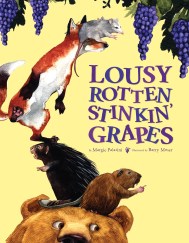 In this twist on Aesop, the fox progressively involves a series of animals in an elaborate plan to help him get the grapes. He refuses to listen to their advice, and when his plan fails, he leaves saying the grapes are probably not ripe. After he leaves, the other animals get the grapes.
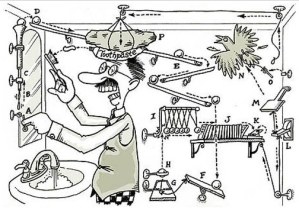 Our fox makes somewhat of a “Rube Goldberg” plan, each part of which is more elaborate than next, and requiring ever more complicated diagrams. The original model of a plan that is too elaborate is named after Rube Goldberg. The illustration is of a machine to brush your teeth. Ask students to create a “Rube Goldberg” plan to do something simple like wash a car, or sharpen a pencil.
 A classic Chinese folktale, of a man who owned a horse and at each turn of fate believed that things were neither as good, nor as bad, as they might seem.
 Alfred Nobel invented dynamite and became very wealthy. Saddened by its us in war he left his entire fortune to a yearly prize for those “who have rendered the greatest services to mankind.”
 How Gutenberg Changed the World. Illustrated like a medieval manuscript, the book shows how all the parts of the process came together to create the first printing press.
 This book is not new, but has been recently re-issued, so I am including it because it is great for writing ideas. The Quiltmaker makes quilts only for the poor. When the king covets one she refuses, but will make one square for each gift he gives away. After several threats, he gives in, and finds that giving to others is where he find happiness.
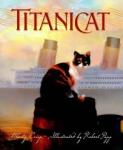 Jim is a cabin boy on the Titanic assigned to watch over a cat and her kittens. He sees the cat taking her kittens off the ship before it sails. As the “All ashore” is called there is one last kitten, so Jim takes it off and misses the ship. Based on a true story.
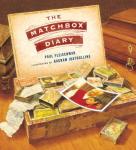 Grandfather has a room full of treasures, each with a story attached. She asks for the story of the cigar box filed with matchbooks, each with a tiny symbol of a story from grandfather’s life.
 The biography of the ancient Greek mathematician and librarian who measured the circumference of the earth, with an error of only 200 miles, at a time when people didn’t even know for sure the earth was round, using math alone.
 Diana Cruchley