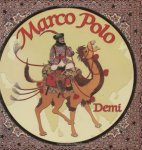
 The story of Marco Polo and his trip from Venice to Beijing starting in 1271 and his return 24 years later. The illustrations are in an eastern 13th century style, with gilding and gorgeous elaborate borders all using Chinese inks. Be selective in your choices of what you read – it is a long picture book.
Demi, Marshall Cavendish Chidren, ©2008, 978-0-7614-5433-5
Here is a three-minute summary of Marco Polo’s travels …without the amazing things that he saw and reported. It could be a quick introduction before you start your selected readings.
The Life Lessons of Marco Polo
Try giving the students a set of potential life lessons we could learn from Marco Polo before you read excerpts from the book. Ask them to listen and select four potential lessons. Tell them they can also draw lessons of their own from your readings. For each of them, they are to write one paragraph explaining how Marco Polo exemplifies that lesson. Discuss their opinions in small groups and as the class.
- Go outside your comfort zone.
- Always record your travels.
- Taste many different types of food.
- Stick to your guns.
- Be prepared to take risks.
- Build a network of connections and friends.
- Work hard for your money.
- Learn other languages.
- Be charming.
Why You Wouldn’t Want to Take A Trip with Marco Polo
An opposite point of view could be taken of Marco Polo’s travels…and that is, all of the privations and dangers he encountered. Ask students to listen as you read, and make a list of things that were difficult on his journey…then to write a letter, or an essay, or a rant about “Why I Wouldn’t Want to Take a Trip with Marco Polo.”
Zentangles
While Demi’s used patterns and designs common in the Middle East in the 1200’s, those are difficult for students to imitate. On the other hand, elaboration of design within an outline can be easily achieved using zentangles. There are many websites and YouTube videos dedicated to zentangle, a popular contemporary “doodle” students can use to create a frame or illustration for a piece of their own writing. Start with a simple outline drawing, and then pattern the inside. This particular YouTube not only demonstrates fitting designs into an outline, it also provides many different patterns students can imitate. Have a set of patterns available on a single sheet of paper for each student as well.
For 10 creative writing ideas, click Marco Polo to download.
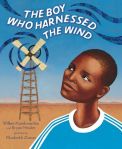 The true story of a boy living in Malawi who created a windmill to generate electricity and pump water for his village.
 A delightful ABC book of circus anecdotes principally focusing on the most famous acts of Barnum and Bailey. It is all done in the style of the big circus posters of the 30’s advertising the next circus to come to town. Visually gorgeous.
 Wabi Sabi, the cat, goes on a journey to find the meaning of her name. She asks a cat friend, a dog, a bird, and finally a monkey. Each says, “That’s hard to explain”—the catch phrase of the book. Slowly she discovers that it is a kind of humble beauty, you will be exploring with student.
 Mr. Button buys a dog; Mrs. Button buys a cat. The two have conflicting habits and fight constantly until their owners bring home – a baby. The problem is solved when the cat and dog reconcile and build a home for themselves in the backyard.
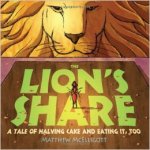 The ant is invited to the lion’s dinner party and is shocked at the manners of the other guests as they greedily “share” the cake. When she herself is accused of being greedy, the ant turns the tables on the other guests.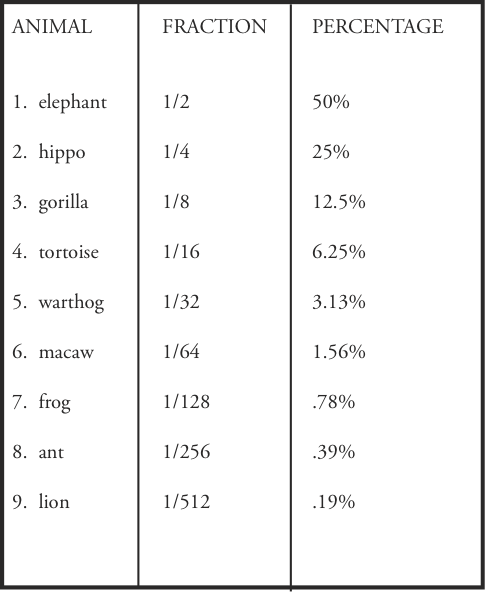
 A classic Chinese folktale, of a man who owned a horse and at each turn of fate believed that things were neither as good, nor as bad, as they might seem.
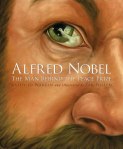 Alfred Nobel invented dynamite and became very wealthy. Saddened by its us in war he left his entire fortune to a yearly prize for those “who have rendered the greatest services to mankind.”
 This book is not new, but has been recently re-issued, so I am including it because it is great for writing ideas. The Quiltmaker makes quilts only for the poor. When the king covets one she refuses, but will make one square for each gift he gives away. After several threats, he gives in, and finds that giving to others is where he find happiness.
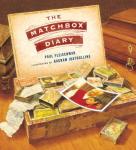 Grandfather has a room full of treasures, each with a story attached. She asks for the story of the cigar box filed with matchbooks, each with a tiny symbol of a story from grandfather’s life.
 Diana Cruchley